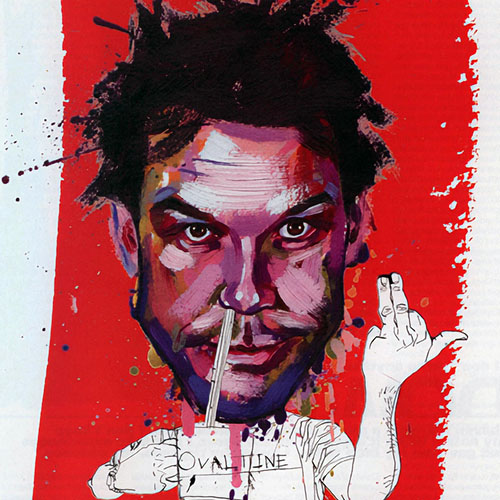
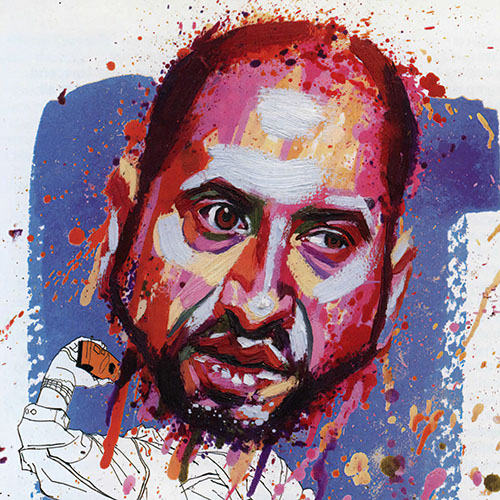
They have a killer new record, but with roots in Glasgow’s no-bullshit music and party scene, these Scottish rockers are always happy to get back home.
Scots Do It Better (with Franz Ferdinand)
Franz Ferdinand don’t like to waste time. They released their first album just nine months after their fifth performance, and wrote their newest You Could Have It So Much Better … With Franz Ferdinand, in a mere four. In the middle of a whirlwind trip to the States before the start of a North American tour, frontman Alex Kapranos, with the help of bassist Bob Hardy, drummer Paul Thomson, and guitarist Nick McCarthy, got candid with Penthouse at Manhattan’s chic Tribeca Grand Hotel.
“There’s something about that kind of raw live performance that we didn’t quite get [with our first record]. We’re getting closer to it now.”
You guys just flew in from Scotland. What did you do when you arrived last night?
Kapranos: We went out and met up with some friends, this other band from Glasgow called Sons and Daughters. They had an album launch last night. Then we came back here and collapsed.
No jet lag?
[Laughs] There was a little bit …. I think it’s always best to go out and not fall asleep. Otherwise you’re screwed. Your days are through.
Was that one of the challenges of writing the record on the road?
You can write anywhere. You can write in the back of a tour bus. You can write in a hotel room. You can write at a sound check. But what you tend to find is when you write in those situations, you have lots of disconnected ideas. We found that when we finished touring last year, we had thousands of scattered ideas, which is great because you’ve got a lot of material to draw from. The hard work was bringing it together and making it into something that would be recognizable as music to other human beings.
What makes You Could Have It So Much Better … With Franz Ferdinand different from Franz Ferdinand?
It’s a bit more emotional. One thing we decided to do was capture some of the energy and intensity that we have when we play live. I think with the first record, that’s the only thing that we didn’t quite get down. We got the songs and the melodies and everything, but there’s something about that kind of raw live performance that we didn’t quite get. We’re getting closer to it now.
What is writing like for you?
Usually, you can’t plan a day of writing. An idea comes to you and you’ve just gotta go with it. I remember when I was a kid trying to explain this to my mum. She’d be telling me dinner was ready, and I’d be like, “No. I’m halfway through writing a song.” I think that was the first time I realized you’ve got to grab the moment, and that everything else going on around you is irrelevant. The room next door to you could be on fire, but getting your ideas down is probably more important.
What’s one of your favorite songs on the new record?
Kapranos: [“The Fallen” is] a ballad in the real sense of the word, rather than a sloppy love song. I was taking a character from real life and turning him into a hero, which is what a ballad really does.
Hardy: Playing it just felt great.
Wasn’t the song influenced by Bob Dylan’s memoir?
Kapranos: When [Dylan] was talking about the folk tradition of writing about characters from your life, that really struck a chord with me. He was talking about the song “The Ballad of Billy the Kid” and how he turned a real character into a hero in the context of the song. You pick and present only the heroic elements of that character. As a songwriter, you’re in this wonderfully privileged position to be able to do that.
Like with the songs “Michael” and “Jacqueline” on your debut record.
Jacqueline is a friend of ours who lives in Glasgow. The first verse is about a time when she was working in London, met an older man, and realized he was attracted to her and how that was odd. It just didn’t cross her mind that he would feel that way. He made some comment, something like, “I may look like an old man to you, but I still have the heart and passion that I had when I was 21.” I always found it moving when she told me that story.
Did they ever hook up?
I don’t think they did. But I think they remained friends.
“There’s a no-bullshit attitude about Glasgow. It’s a city where the audience either loves you or hates you — and they’ll really let you know it.”
What was their age difference?
About 60 years. I hope when I’m in my eighties, I still have the same passion for life that I had when I was 21. That would be a great, great thing. “Jacqueline” is about having a passion for life. That’s one of the themes that runs through the new album. A song like “What You Meant” is about talking to somebody who’s given up and keeps on making negative comments, to which I say, “No. I don’t feel like that at all. I still feel blood running through my veins. I feel life inside. I’ve got a passion for all that stuff.”
What’s the story behind the record’s first single?
“Do You Want To” was written after we went to a party in Glasgow. It was a really good party. In fact, it was an excellent party.
Why was that?
When parties are working at their best, there’s a certain level of abandonment and decadence in that people don’t really give a damn about what others think of them. People were talking, but because the music was loud, you couldn’t really have a conversation. People were just shouting statements in each other’s ears, and because they had had a couple of drinks, the statements were quite abandoned. Some really funny things were being shouted in my ear. I came home that night and wrote a whole bunch of them down, and the next morning, slightly hungover, I picked up my guitar and started singing some of those things. The band met up a couple of weeks later and we turned it into a song.
Originally, this album was titled Franz Ferdinand, like your debut. Why did you change it?
Three days ago, we were sitting at this hotel in Geneva talking about different names, and said, “Oh! That name would have been good for the album.” I had given it a name, too, and we said, “That would have been good.” And then we said, “Hold on. We haven’t even released the album yet. What’s going on?” So now the album’s called You Could Have It So Much Better … With Franz Ferdinand.
Better as in … ?
Yeah. Saucy. [Laughs]
Nice. Where did you record it?
We moved to my house in the countryside just south of Glasgow and lived there for a couple of months. We wrote and recorded the record there. It was great because it was the perfect combination of feeling remote and being in an idyllic country setting, and we were a five-minute walk from the oldest inn in Scotland.
Why do you think Glasgow has such a strong music scene?
There always has been an independent attitude toward making music in Glasgow. I think it’s partly because it’s geographically so far away from London, and people want to make their own scene and do it their own way. There’s a no-bullshit attitude about Glasgow, which is great for developing as a band because you can’t get away with anything pretentious. It’s a city where the audience either loves you or hates you — and they’ll really let you know it. If they love or hate you, they’ll throw glasses at you. In fact, if they love you, they’ll throw more. It’s their way of saying, “We love you so much, we’re gonna share our beer with you.”
Is Glasgow different for you now than it was before?
Hardy: Whenever we go back, we still hang out with the same bunch as when we were just kicking around.
Kapranos: It’s great because your real friends treat you exactly the same way they did before. Sometimes it feels like we’re the only four people that stayed the same in the world and everybody else has gone crazy.
Can you give new fans a short rundown of Franz’s history?
Thomson: I was living in Edinburgh and Alex was living in Glasgow, putting on bands in this cafe. I moved to Glasgow and joined a band because Glasgow had a music community where everybody supported each other, which didn’t exist so much in Edinburgh. That’s how I met Alex.
Hardy: I moved to Glasgow in ‘99.
Kapranos: Nick and I met at a party. We had a fight over a bottle of vodka. Nick stole it from me, and I won it back. But somehow in the middle of all that, I asked him if he played the drums, because Bob and I were thinking of getting a band together and we needed a drummer. Nick said yes, and we met up the next day. He didn’t play the drums a lot that day, but we worked on some great songs together.
McCarthy: I had just moved to Glasgow four months before that and was looking for bands. Nothing was happening, so I started placing ads in music shops and other places. That wasn’t the way to go. I had these crazy people showing up, including this balding old guy who wanted to play Iggy Pop songs. I was actually ready to pack up and go. I didn’t have a job or anything. I didn’t have any money. The day I hooked up with Alex saved everything. It was May 22nd.
Kapranos: Once the four of us began playing together, you could feel there was something different happening. You know you’ve got a good group dynamic when you go through ideas very quickly and you’re writing songs in an hour. What’s interesting is, Bob had never played an instrument before he joined the band. When we first started playing, Paul was on guitar. I was singing, Bob was playing bass, and Nick was playing drums standing up.
McCarthy: It was terrible! I think it was like one beat.
Kapranos: The moment Nick and Paul swapped, everything just clicked.
“Usually, you can’t plan a day of writing. An idea comes to you and you’ve just got to go with it …. The room next door to you could be on fire, but getting your ideas down is probably more important.”
Why do you like the name Franz Ferdinand?
Kapranos: I think the most important thing about our name is that it sounds good. We also like the idea that when [Austrian Archduke] Franz Ferdinand was assassinated, the whole world changed [and World War I began]. I think that’s what all bands should aspire to: the idea that after their existence, nothing’s quite the same in the world of music. Nirvana, the Clash, and the Pixies are like that.
Besides the Beatles, what bands influenced you growing up?
Hardy: Queen, Belle and Sebastian, and Roxy Music.
Thomson: I was a big Belle and Sebastian fan, too. I was also into Talking Heads and Neil Young.
McCarthy: I think the first record I owned was by the Specials. My brother is a big punk rocker, so I got into his records, the Dead Kennedys and all that stuff.
Kapranos: I was totally obsessed with the Beatles in my early teens and when I first started writing songs. But I was really into the early rock ‘n’ roll and garage-y sort of stuff, too, like Link Wray and the Cramps and a lot of punk rockers. I like the Clash and the Dead Kennedys and the Specials. I think there’s a certain kind of music that appeals to teenage boys. You have so much boisterous energy at that age, and that music allows you to burn it off in a positive way.
What do you keep in mind when you’re performing?
Kapranos: When we got the band together, we said we were going to meet the eyes of the audience. We’re not going to avert our gaze. There’s an air of abandonment that you have to adopt. If you’re going to pull that off, you have to lose all self-consciousness and you can’t give a damn about falling over or making an idiot of yourself. You have to just totally go for it.
Fair warning, should you simply try an obvious shortcut web address to seek more information, you might be fairly confused. We’re fairly certain this cutting-edge cool-kids group from twenty years ago did not somehow morph into Southern Culture on the Skids. Call is a hunch. … All in all, you will have more sucess sticking with the band name as you seek contemporary edification.