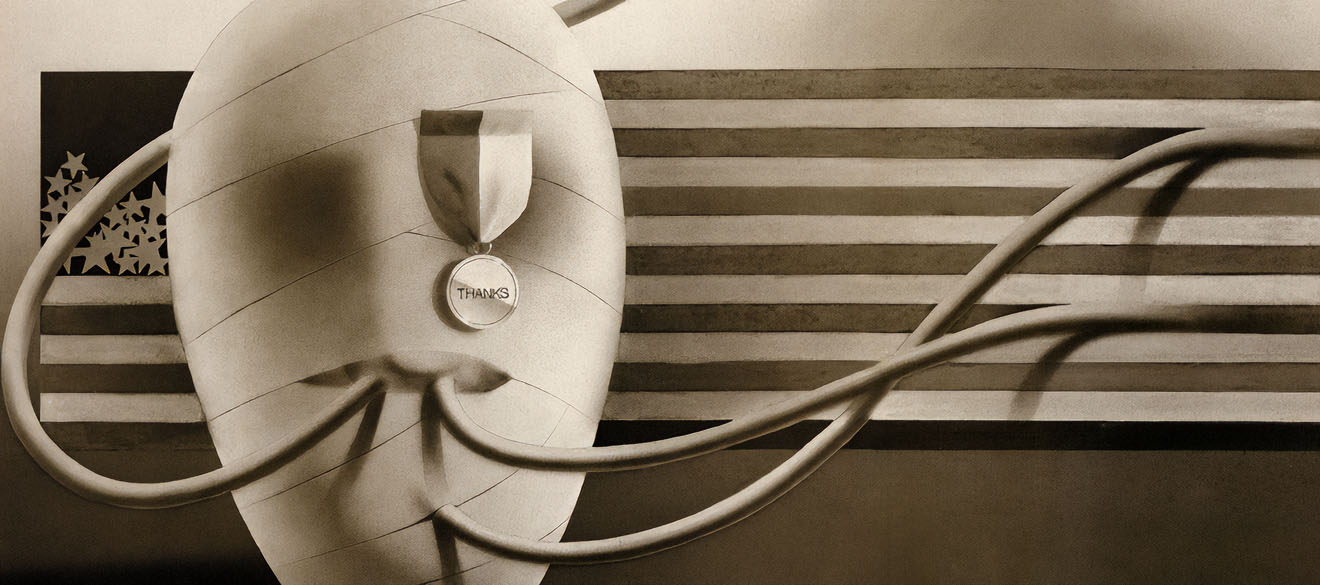
Vietnam Harbinger

The Vietnam Veteran Body Count

Vietnam Vet Bob Sampson

Bob Sampson came within three days of walking home. Sampson was a “green beanie,” a jungle thug from the Fifth II Special Forces, trained to be something between boy scout and Attila the Hun. He was attached to the Seventy-fifth Ranger Regiment. The beanies helped the Army of the Republic of Vietnam troops watch over the Mekong Delta south and east of Saigon. Sampson, an E-5, spent two tours in Nam leading six-man teams around Cong turf in search of information. Long on experience, Bob Sampson turned up short on luck. On January 1, 1970, the captain took him aside and told him that this next mission would be his last. Only two days later Sampson learned the captain was all too accurate.

Sampson’s reconnaissance team was set up in what the army manual calls a “day halt position”-rifles spread in a defensive perimeter facing the surrounding jungle vines and triple-canopy plant life. Two days before, the team spotted a North Vietnamese army division in the neighborhood. The team leader was worried. Sampson sensed safety in motion. He gave the order to mount up, and raised to a crouch, trying to hunch his pack onto his shoulders. When he did, his future was sealed. A North Vietnamese soldier stood in the chest-high grass only ten feet away, and laced Sampson with AK-47 fire. Two of the bullets whined through Sampson’s left leg. A third hit his hip. Bob Sampson toppled into the muck, and the rest of the afternoon swarmed with automatic-weapons fire.

The bullets that entered just above his knee did the job on Robert Sampson. Right away he knew he’d have to change his plans for the future. Sampson figured on attending commercial pilots school after his discharge, but he immediately knew there wasn’t much flying to look forward to. The rounds pulverized five inches of his femur. Shivering on the floor of a Huey hut, headed for Saigon, Sampson thought he wouldn’t have his leg much longer, but the doctors proved him wrong. He regained consciousness in intensive care, and his leg was still attached. Sampson wanted to thank the surgeon personally.

The doctor was making his rounds through the ward, bed by bed, checking charts and adjusting tubes. When he reached Sampson’s bed, the E-5 interrupted his progress.

“Hey, Doc,” Sampson offered, “I want you to know that I really appreciate you saving my leg.”

The doctor was blunt in return. “I didn’t save your leg,” he answered. “I just didn’t cut it off.”

When the surgeon turned back to his charts, Sampson’s smile drifted off his face. For a brief moment he believed the road to recovery was a short one.

It wasn’t. The Nam hospital disappeared in the dust of a taxiing C-47 and was replaced by another hospital in Japan. After two more sessions on the operating table to have bone splinters removed and tattered muscles snipped, Sampson was shipped to San Francisco’s Letterman Hospital. It was January and he was still flat on his back. The army doctors wanted to operate as soon as they could, but changed their minds about it each week. When March rolled around, Sampson was still waiting. He felt worse and worse while he waited — lying in bed watching juice ooze out of his knee. And the doctors’ visits didn’t help — especially the first visit in March.

This doctor was new. He looked at Sampson’s charts, at Sampson’s X-rays, and at Sampson’s leg. His head was shaking the whole time. “You know,” he said, “if I’d been your doctor in Vietnam, ’I’d have taken your leg off there. By all rights, you shouldn’t even have it.”

None of the surgeons wanted the responsibility of cutting Sampson’s leg off, but they didn’t mind experimenting with it. He got all the benefits of ultramodern medicine. The doctors tried bone transplants, nerve transplants, and bone grafts. During the next year Sampson underwent surgery seven times … for as long as eight hours at a shot. That makes for a lot of painful days and weeks for anybody — but Bob Sampson suffered doubly. He would have felt it was worth something if his condition changed. Lt didn’t. By January 1, 1971, Bob Sampson still had his leg, still couldn’t walk on it, still had an open wound, and had added a marrow infection. Called osteomyelitis, the disease is frequently caused by short bursts of gunfire followed by long surgical histories.

Finally, his condition stabilized. Sampson was released from Letterman Hospital on crutches and told the next step was called wait-and-see-what-the-leg-doesnext. Maybe some of that stuff they’d sewn in his leg would work. Meanwhile, Sampson was discharged and given a choice of benefits. Either military or Veterans Administration payments were available — but not both. The army rated Sampson’s leg 80 percent disabled and offered him 80 percent of his E-5’s pay a month. The VA’s figures amounted to more cash, so Sampson signed on with the civilians. After his first visit to the VA, Bob began to have doubts about his choice.

He went down to San Francisco’s Ft. Miley VA in response to a request that he appear for an examination. Robert Sampson reported to the VA precisely on time. Three and a half hours later, a nurse told him he could see the doctor. His doctor was a general surgeon who didn’t know his ass from a hole in the ground about orthopedics and was honest about it. He said the best thing for Sampson was to make another appointment and see one of the guys who worked on bones. Sampson did, waited three and a half more hours, and passed his examination with flying colors. The knee was hard to ignore. When the doctor pulled out the gauze, he saw al I the way down to the bone through a wound the size of a silver dollar.

“You’re one hundred percent,” the surgeon gravely announced.

That approval was good for eight months — but not longer. In late 1971, Bob Sampson got a card telling him to come in for a revaluation to see if anything had changed. The new examination came at the wrong time. Bob Sampson was going to Chicago to get married; he wasn’t about to postpone his trip. On the back of the VA’s card, a printed section announced that anyone who found it impossible to make his appointment had only to fill out the card and send it back. Sampson did as directed and left town.

When he got back, Bob wasn’t feeling nearly so easy about his leg. It hurt like a motherfucker and oozed. When he called the VA asking to see a doctor, they told him his appointment was being rescheduled as he’d requested on the card. There was no chance of seeing the surgeons before then. Sick of waiting, the retired E-5 used the hospital privileges available to all “disabled “ veterans. He checked back into Letterman and let the doctors there have another look. They said his leg was seriously infected.

While the doctors were deciding what to do, Bob Sampson’s wife brought over another card from the VA announcing his new appointment. Sampson filled it out and forgot about it. He had other things on his mind.

The doctors believed experimental therapy on the bone marrow would be helpful and so sent Bob Sampson to the Long Beach Naval Hospital where he spent a few months in and out of decompression chambers. Unfortunately, the osteomyelitis wasn’t affected by any of the new techniques. Bob Sampson was tired of hospitals, but he was even more tired of those damn messages from the VA. His wife called him to say the VA cut Sampson’s benefits to 60 percent.

“What the fuck?”

“The letter says it’s because you missed your last appointment,” his wife explained. Four months later, Bob got everything straightened out with the Veterans Administration. In the meantime, he and his wife went from living on $495 a month to $179. The whole mess forced Sampson to make one of the most important decisions of his life. He told the surgeons back in San Francisco to cut the son of a bitch off. Two days later, he was walking on a plastic leg, feeling like they’d cut the load off his back.

Things are a lot easier now. Sampson has a job at the San Francisco State Veterans Center. He wears a leg that straps on to the end of the stump halfway between the knee and the hip. And except for his monthly check, he stays clear of the VA. If he didn’t, he knows what would happen. “I’d go to the VA hospital,” he explains, “and I’d say, ’I got a problem with my leg.’ They’d say, ’Make an appointment for three weeks from now.’ In three weeks, I’d go out there and sit for hours. By that time, the damn leg’d fall apart. What I do instead is go on out to Letterman. They’ll take care of it right while I wait. It’s the same way with alI the amputees.”

The specific department Sampson visits at Letterman is prosthetics. Sergeant Anderson, who is in charge of the seven-man shop, has been building legs for eleven years. The laminated-foam limbs are custom built and each is equipped with a hydraulic knee. The artificial leg is not the same as the one Bob Sampson had, but it does the job — and that’s all he wants now. The shop is assembling a new model for Sampson so he can play golf. The one he has folds up halfway through his swing.

Vietnam Vet Gunny Musgrave

Gunny Musgrave was a long time “in country,” too. The grunts called him Gunny because of his gunnery-sergeant rating. He’d been with the First Battalion, Ninth Marines, fighting out of Con Thien just south of the DMZ for eleven months, nine days, when he received what the telegram to his parents called “wounds in the face, chest, and back.” After eleven months, seventeen days in Indochina, John David Musgrave, 2294574, 19 years old, was on his way back to the States in a hospital transport.

Gunny was wounded on Operation Kentucky, during which the 1,000-marine base was surrounded by 35,000 NVA regulars. The papers back home called Operation Kentucky “The Alamo. “ Attempting to break out of the trap, Musgrave’s Delta Company was sent north from Camp Carrol I to meet with another company in a pincers movement. The two groups never met. A thousand meters out, three NVA stood up, popped at Delta Company, and then took off.

Gunny’s platoon was led by a first-mission lieutenant fresh from OCS. The lieutenant reported the gooks to the captain and the captain said, “Bring me their bodies.” Gunny and the grunts warned the lieutenant of a trap, but he wouldn’t listen. The Third Platoon went off into the deep grass. After a while, the grunts saw moving figures all around them. They noticed the men were wearing steel pots and marine flak-vests. The men shouted, “Don’t shoot. We’re marines.” It was Halloween and the disguised NVA called “trick or treat.”
Lenny Blair got hit first, and then all hell broke loose. Within the first minute, both corpsmen were dead. Gunny decided to help Blair. That was his mistake. Five meters short of the wounded marine, Gunnery Sergeant Musgrave got caught in a spurt from a machine gun. The round hit his chin and ricocheted through the lip of his helmet. Gunny was out cold and B.J. Forbes, his best friend in the platoon, came running. Forbes picked Musgrave up and so did the machine gun. A second burst blew Gunny out of his buddy’s arms. It smashed Gunny’s chest and blew most of Forbes’s head away.

The platoon finally got Musgrave and Blair to the medevac choppers. The grunts never abandon their wounded, no matter how badly they’re injured. And Gunny was bad. Even if he didn’t trust his own judgment, the conversation he overheard at the landing zone confirmed it.

The company’s executive officer was talking to a corpsman on the other side of Gunny’s litter. The two spoke as though the gunnery sergeant wasn’t there.

“Looks like Musgrave bought it this time,” the exec said.

The corpsman looked up. “It’s either through the lungs, or heart … or both,” he answered. Gunny wasn’t even tagged for evacuation. The ground crew figured he’d be dead before he got to a hospital.

Gunny swears he would have been dead if it weren’t for the chopper’s gunner. As the copter struggled out of Con Thien — bullets shaking the tail and blowing holes in the belly — the man on the belt-fed M-60 fired with one hand and held on to Gunny with the other. Every time Musgrave started to fade out, the gunner gave him a hard shake and brought him back. Gunny was still breathing when they landed at Dong Ha.

The doctor there took one look and said, “There’s nothing we can do for this kid. What’s his religion?” Gunny whispered, “Methodist.” The doctor cut a hole in his side, then inserted a tube into his chest to drain the hemorrhage. The orderly hooked blood up and called a chaplain. After the chaplain finished praying, the surgeon came back. He leaned down by Gunny’s ear.

“We’re going to take you to Phu Bai,” he said. “They can do more for you there.”

Phu Bai was just a short flight away and when Musgrave arrived, he was all set to call it quits. Fortunately, the Dong Ha doctors were right … the doctors at Phu Bai were able to do more for him. After eight days in intensive care, he went home. John Musgrave wasn’t the same as when he’d arrived in Vietnam, but at least he was alive. The machine-gun burst had shot away most of his chest muscles, two of his ribs were blown to splinters, and his left lung had been reduced to a thin pink liquid that ran out of him through pipes into a jar kept beside his bed. A bullet was still lodged against his spinal cord. Before he left Nam, a general came by and pinned the Vietnamese Cross for Gallantry, Gold Star, on Musgrave’s sheets.

For the journey stateside, the doctors closed the bullet holes with thick-gauge surgical wire. They shipped him to Clark Air Force Base in the Philippines. From there it was on to Japan, Alaska, and a final touchdown at Scott Air Force Base, Illinois. When they carried Gunny Musgrave off the transport, it was snowing. Gunny felt the flakes on his cheeks and cried.

After another month at Great Lakes Naval Hospital, Gunny’s wounds closed up enough for him to go to St. Louis on leave. A month after that, the navy surgeons gave Musgrave his final examination. Gunny felt great … except for the pains in his chest … and he couldn’t lift his left arm higher than his shoulder. The doctor finished the exam and gave Musgrave the good news.

“You’re fit for duty,” he said.

“But I’m having trouble with my left arm, sir. I can’t lift it.”

“That’s not our problem,” the doctor shot back. “That’s up to the orthopedic people.”

“But sir,” Gunny argued, “you just released me fit for duty. You’re not transferring me to another department.”

“That’s your problem, Marine. You’re finished in surgery.”

Gunny didn’t know what to do. When his orders came for Quantico, Virginia, Gunny decided to go ahead. He loved Virginia and the assignment was a good one — a Weapons Training Battalion where he’d instruct officer candidates in small-arms marksmanship. Once there, the job didn’t last long. Shortly after his arrival, the NCO in charge of the firing range ordered him to do something that required raising his left arm over his head.
“Excuse me, Sergeant, “ Musgrave said, “my arm won’t go up that high.”

“What?”

“It’s true,” Gunny continued, pulling off his shirt to show the scars.

“Jesus Christ, grunt,” the amazed sergeant roared, “get down to sick bay.”

At sick bay, the medics said he should never have been released from the hospital. The gunnery sergeant was given a room in Quantico’s facility and spent the next twelve months in physical therapy. When the year was up, a naval medical board reached the conclusion that Gunnery Sergeant Musgrave would never raise his left hand past the shoulder again and placed him on the “temporary disability list.” If after five years, they explained, there was no improvement, he would be moved to the “permanent disability list.” From the point of his discharge, Musgrave would be eligible for payments at 70 percent of his base pay.
Gunny went with the VA because the money was better. They rated him 100 percent disabled. At the time, it was a little over $400. “I felt they were trying to cut me a good deal when they examined me,” Musgrave remembers. “But the next time, I felt Iike they were trying to cut my feet out from under me.” The VA reduced the ex-Marine’s disability to 50 percent, reasoning that only half of him was disabled. The reduction meant a drop to $145 a month.

Fortunately for Gunny, the Marine retirement program was designed with the VA’s fluctuations in mind. If you sign on with the VA and the VA reduces your disability below the sum you’re entitled to under the Marine plan, the Marines make up the difference. For John David Musgrave, that amounted to $77 each month. For a long time, Gunny lived on his $232 a month. Now he’s got a job in a bookstore. It’s a good thing — last year he lost his Marine check.

The Marine Corps sent Musgrave a letter saying his first five years were up and it was time to be examined for the permanent disability retired list. His orders were to report to a naval hospital in Memphis, Tennessee. Both of the doctors who saw him there said he’d go on permanent disability at 70 percent. At the end of March 1974, the Marine Corps disbursement center in Kansas City sent a letter instead of a check. Since the center hadn’t heard from Marine Corps headquarters in Virginia that John David Musgrave, 2294574, was still a disabled veteran, they were ceasing payment. When Gunny called Marine Corps headquarters, they said they didn’t have any evidence that he even reported to the hospital in Memphis. Musgrave’s been trying to get his check ever since. So far, the Disabled American Veterans and the Kansas State Veterans Committee have both made inquiries on his behalf and have received no answer.

To be honest, Gunny Musgrave isn’t surprised. He believes the universal condition of Vietnam veterans is to be fucked around. “We’re living evidence,” he explains, “of a war that people want to sweep under a rug. So they’re gonna sweep the disabled veteran under the rug with it. Wherever we go, we are the war in Indochina. I think about that war all the time. I have to. I can feel it. When I reach with my left hand and al I of a sudden it stops and I get a shot of pain, I know what that war’s about.”

Gunny’s body looks like a plaque in honor of the history he was forced to live. On his left side, there’s a crescent-shaped scar an inch long. There are two more on his chest -the longest is over four inches. Another scar meanders down his back. In 1972, he got USMC tattooed on his arm because he was tired of answering questions about his scars when he went to the beach.

Vietnam Vet Mike Valentino

Mike Valentino has never had a problem getting his VA benefits. His check for $1,250 shows up every month on schedule. Mike’s saddled with one of those wounds nobody questions: his body is still alive, it just doesn’t know it. From the armpits down, he has no feelings. He just hangs loose lie a rag doww and shits at random. Valentino is paraplegic. The last time Mike used his legs was March 25, 1968.

Valentino was a medic with the Twenty-fifth Infantry Division. Attached to a column of armored personnel carriers, the infantry was on its way from Trang Bang to Cu Chi, early in the day. Up ahead and off to the right, Valentino could see gunships circling and spraying the jungle with rockets. When they got close to the action, the dogfaces were ordered off the road and across the paddies. They couldn’t move through the mud, so Valentino’s company just made a skirmish line and waded forward knee-deep in rice. Halfway across, the woods opened up, blowing infantry every which way. The lieutenant cashed in his chips in the first few seconds. Everyone else around Mike ran forward to the closest dike and took cover. Before Valentino got there, a Cong bullet had blown off the top of his toe.

It hurt like hell, but the wound wasn’t that serious. Not nearly as bad as Tom’s. Tom was Valentino’s friend, even though Valentino can’t remember Tom’s last name anymore. Tom was wounded, laying in the open. He called for his buddy.

“Medic,” he groaned at first. “Medic.”

When no one came, Tom used the personal approach. “Mike,” he begged. “Mike.”

That was too much for Valentino. Bullets were dinging off the berm and he didn’t want to go, but he did. When he reached Tom, Valentino strapped a pressure bandage over the hole in his bowels and hoped Tom would last until they got out. Valentino looked up from his wounded friend never to use his legs again. A bullet entered through his throat, cut his spinal cord behind his head, and lifted him straight up in the air.
Mike Valentino lay face down in the paddy for twenty minutes before the army picked him up. At first nothing hurt. His body was in shock. Valentino’s biggest worry was choking on his own blood. Then the shock wore off. From that point on, pain blurred the day for Mike Valentino. He remembers finally being jammed through the rear hatch of one of the tracks and landing in the chopper at Cu Chi’s Twelfth Evacuation Hospital. The first doctor to get to him after the medics cut his clothes away and stuck a probe into his mouth.

“Can you feel that?” the doctor asked.

Valentino screamed. He “came to” three days later.

When his eyes opened, the first thing Mike noticed were the tubes. They were sprouting from his nose and side. He was suspended on a striker frame and could only breathe in sips. His left lung was collapsed and his right lung was fed by a hole cut in his windpipe. On that first day he was awake, Mike Valentino was sure he was going to die. Every few hours, the medic used a machine to force air into his lung and suck congestion out. That meant one more tube down his throat. He felt like he was being choked each time the machine was hooked up.

After a week in intensive care, Mike wasn’t so scared. He began to assume he’d make it, and his thoughts turned to just how that was going to be. He knew he was hurt, but he didn’t know how bad. The day he found out how bad things were, it was 120 degrees outside. With only a small fan in the corner of the ward, the Quonset hut hospital was a forty-bed oven. Since Valentino wasn’t allowed to drink fluids yet, he had to do with a moist cloth pressed to his lips for sucking and chewing. The doctor walked up to his bed in a hurry and planted his feet.

“Valentino,” he began, “your spinal cord’s been severed. You’re paralyzed. You’re not going to walk again for the rest of your life.” The doctor didn’t stick around to answer any questions. He turned on his heel and headed for the next bed.

His condition is something Mike has since learned to accept. “I got used to it,” he explains, “because I didn’t have much choice. Even now, you get depressed because you can really think of a lot of things you really missed out on. But if you keep on thinking about things like that, you’d go out of your mind. You’ve just got to decide you’re paralyzed and you’re gonna be that way for the rest of your Iife and do the best you can with what you got.” But Valentino thinks of himself as lucky. Had the bullet struck a half-inch higher, he would have been a quadriplegic, denied the use of his arms too. He’s grateful he still has those.

Mike’s parents found out about his wound in spurts. The first news was a telegram on April Fools’ Day. “Your son,” it read, “Pfc Michael Valentino, received gunshot wounds in the chest, neck, and back on March 25. He is in critical condition. We will keep you informed of all new developments.” His mother got hysterical and only calmed down when the family doctor guessed that, because of alI the places the message mentioned as wounded, Mike must have been hit with a shotgun blast. That, the doctor explained, wouldn’t be all that bad. So she wasn’t quite prepared when her son was finally shipped stateside to Letterman Hospital.

She and Mike’s brother stood at the foot of his bed. “I’m paralyzed,” Mike said. Mrs. Valentino didn’t believe him. She interrogated the neurosurgeon and, until Mike stopped her, wanted to bring in an outside consultant. It wouldn’t have done any good. Mike Valentino’s walking days were done. All that was left, Valentino told himself, was learning how to live on wheels.

The place he was sent to do it was the Long Beach VA Hospital. It took Mike a year, which is longer than most. He went slow because he still had medical problems. While at Long Beach, his lung kept collapsing and forcing him onto his back. When the lung finally filled up and stabilized, Mike returned to his routine. Aside from counseling and getting their bladders drained, the ward was full of paraplegics attending physical therapy to keep their shriveling legs from getting stiff, and corrective therapy with weights to develop the muscles that could still be used. Instruction was given in handling chairs and transferring from them onto beds and toilets. When the program was over, the former Pfc could take care of himself, cook his own meals, and drive a car with hand controls. The only thing left to learn was called back-to-the-world.

Which isn’t all that easy a place for the paraplegic to be. The most common danger to spinal cord injuries is from their own numb bodies. The bladder and bowels are not subject to any effort of will; they either drain sporadically on their own or have to be coaxed to empty. As a result, the biggest killer of paraplegics is bladder infections. The biggest discomfort is the curse of their position: they sit. The body rests on the bony protrusions upon which the butt is built. Most folks can feel their ass on the chair and shift automatically, creating little movements that relieve the pressure on any one patch of their butt’s skin. If they didn’t, the skin would break down and begin to form sores that eventually bleed and leak. Which is exactly the common plight of someone bound to a chair. They spend all their time out of bed sitting on one spot and not being able to notice when the butt tells the brain to lighten up. Their butts get raw, and the smallest scratch becomes infected in short order. Hot coffee spilled in the lap means a trip to the hospital where you lay on your stomach and wait for your ass to heal.

That’s happened to Mike Valentino a lot. He’s been in and out of the VA hospitals for the last year and a half. His problems started with an infection the doctors identified as a simple abscess. They “cut and drained.” Mike healed up long enough to leave. Then he was right back again with more drainage. On five separate occasions, the doctors repeated the treatment with no success. Finally Valentino was taken to surgery and the whole spot was cleaned.

It’s not so hard on Valentino now. The Palo Alto Hospital has opened a new spinal cord injuries center and it’s the nicest place he has ever seen. He’s back with a rectal infection now and will be there for a few more weeks. “When I leave this new place,” he predicts, “I don’t particularly want to come back. But when I come back, I know it’s not gonna be that bad. If I had to come back to that old building, I’d think about it for three weeks. It’s a dungeon.”

Mike has come to accept his condition, but not the place where he got it. “The war,” he says, “was worthless. It’s just the fat cats in the city, that’s who we were fighting for. It was crazy.” The last time the army got in touch with Mike Valentino was three years after his final day in action. He got a box in the mail marked U.S. Government on the return address. Inside was his Purple Heart and a brief note apologizing for the delay.

Vietnam Vet Don Rice

Nobody knows better than Don Rice what a crazy war it was. After he got back from two and a half years of it, Rice changed his name to Maximum Casualty and became Max to everyone who knows him. Max crossed the ocean in June of 1966 with every intention of being a professional soldier, but more shit seemed to collect around him the longer he stayed. Max’s wound is a map of Vietnam burned into his brain.

Max made it through his first combat tour easily enough. He had a temper — that accounted for a spotty military career in which he was shifted from helicopter mechanic to door gunner to infantryman. The only heavy action Max saw the first time around was the Battle of Pleideranj on November 11, 1966. Max and his chopper crew had loaded 228 dead Americans before it was over. The next week’s Seattle newspaper printed the total American casualties for the week as 116 dead and wounded. As soon as he put the paper down, Max knew something weird was going on, but basically he still liked the army. Liquor was two dollars a quart and things were still light enough that he wasn’t worried. When Max requested another tour, he was sent stateside to rest up.

It was back home that Max’s war began to go a little sour. He was drunk most of the time but stayed sober long enough to find out Nam had taken its toll of little Winfield, Kansas, where he’d grown up. Max’s high school debate partner had been paralyzed from the waist down, the boy up the street had both lungs shot out, and his cousin had come home in a box. Visiting Wichita, Max saw his first antiwar demonstration. In the middle of it, a green beret ran into the line of march, knocked down a girl carrying a Vietcong flag, and kicked her in the face with his combat boot. A week later, Wichita had a race riot-Max cruised through the streets, watching the National Guard column move in convoys towards “niggertown.” Max bought a· .32 pistol just for safety’s sake when he was home on leave. In a way, he was glad to report back for duty. Max felt more at home in Cu Chi than in the Midwest. The realization was all the excuse he needed for one more drink. The night before he embarked from Ft. Lewis, Washington, the base theater was rocked with a grenade explosion. An agent from the military police had been killed.

In May, Max was back repairing choppers nine miles north of Saigon. By September, he was behind a machine gun in a chopper door hosing down the bushes with .30 caliber fire. Right away, his outfit was sent south to Phu Cat. Their duty was supposed to be training the Two-Hundred-and-Fifth Division, but they fought the Battle of Phu Duk instead. When it was over, the Army’s First Infantry Division was knocked out of the war for six months with 33 percent casualties. During the fighting Corporal Beefheart on Max’s chopper crew won the Distinguished Flying Cross. The bird was all shot up and Beefheart saved it by sticking his middle finger into a hole in the aft transmission. His act kept scalding oil from leaking out. Beefheart’s finger was amputated at the hospital, but he refused to go home. He went back to flying missions and got his face shot away the next time he went up.

After Phu Duk, Max’s outfit was sent north to reinforce the 173rd Airborne. The generals were expecting what was later called the Battle for Dak To and Hill 875. The battle hadn’t developed by November and Max was still there, demoted to the infantry, and in charge of a perimeter guard. The base was 250 meters from a village called Phu Hep. Max was on his way back from Phu Hep to close the perimeter for the night when the Cong opened up with mortars and recoilless rifles. Max was blown sixty feet through the air. Except for a little shrapnel in his back, he was uninjured. Two weeks later, Max was sent to the hospital to be treated for jungle rot. While he was in the hospital, everything they’d been waiting for happened.

In the Battle for Dak To, the Fourth Infantry lost a thousand men in three days. The 173rd Airborne lost 1,500 men to reach the top of Hill 875 and find that there weren’t any Vietcong there. The field hospital Max was in handled 3,000 wounded in the first twenty-four hours. Max’s old battalion lost forty choppers, sixteen of them blown out of the sky lost full crews. The papers listed 553 American dead for the week. When Max was released for duty, he and his outfit limped to Na Trang to regroup. Na Trang was supposed to be a “secure area.” The first afternoon Max’s chopper spent there, the crews watched a pitched battle raging across the surrounding mountain side. That night Na Trang took mortars, rockets, and a full-scale ground attack. During the fighting, Max had a 76 mm shell pass right over his head. Two men behind him were blown to shreds.

And that’s the way Max’s winter in Na Trang went. The choppers stayed at home half the time and the rest of the time were out on the road. In December, they were ferrying troops into Camp Carroll and took 1,000 122 mm rockets in fifteen minutes. Camp Carroll was leveled. By January, everyone knew something was coming and it would be big. Max was drinking a quart of liquor every evening and flying all day. When he wasn’t in the air, or too drunk to notice, Max was in the nearby village with his woman. Her name was Kim Wa. She was fifteen years old, and she cost $50 a month. Max had known her when he was in Na Trang on his first tour. When Max came back she ran up to him on the streets, held a baby up to him, and called Max “Daddy.” Max bought it, and set up housekeeping in her place.

Max was on his way out to her when the Tet Offensive began. The base had been on alert for two weeks, but Max had a few drinks and decided he didn’t give a fuck. When Max reached the nearby village, it was overrun by two regiments of Vietcong. As Max huddled under cover, he watched an American airstrike on the refugee neighborhood where Kim Wa lived. The planes used napalm. It spread in a flaming carpet, the heat sucking a windstorm in. Kim Wa, her baby, and half the women who worked in the base laundry were burned to a crisp. Eight hours later, Max started screaming in his platoon commander’s face and wouldn’t stop. E-4 Donald Rice ended up in the hospital tagged “battle fatigue” and well on his way to becoming Maximum Casualty.

Max was sent to Okinawa. The psychiatrist there told him he needed “rehabilitation.” That sounded fine to Max until they told him that rehabilitation translated as “Nam-one-more-time.” He spent his last three days in Okinawa at a bar, staying drunk.

Max spent his first night back in the war huddled in a drainage ditch at the Replacement Depot under an all-night mortar attack. He was trying to keep a man with shrapnel wounds warm. After six hours, the man bled to death. The next day, when Max reported for assignment, a man to his left accidentally killed two people with his new M-14. It wasn’t any better out with the Twenty-Fifth Infantry where Max was sent. Max was a convoy guard, covering the truck’s flanks with a machine gun. On their way from Long Binh to Cu Chi, the convoy lost a hundred of the tanks and the APC’s in their escort. Short of Cu Chi, the trucks were abandoned and the whole outfit jumped on the tracks and ran the rest of the way. Max’s unit had nothing to do without their trucks, so Max was sent back to Can Tho.

The day he got there, Max was put on the perimeter guard’s outer layer. When the sergeant checked the watch and found out Max had only been in the outfit for eight hours, he moved the new man back to the second row. Max’s replacement had his head blown off in that night’s Vietcong “probing action.” Max was sent back to the front row and in the next night’s attack, his freshly issued M-16 jammed. No one had bothered to test it. Before the night was over, the VC had come through the wire and destroyed the airfield.

It was all getting to Max. The troops at this point “lost morale.” The day the news of Martin Luther King’s assassination in Memphis reached Can Tho, all the lifers were flying confederate flags and celebrating in the NCO Club. The outfit’s blacks were clustered around radios listening to Radio Hanoi playing live tapes of battle sounds from downtown Detroit. In a few days, the front of the NCO Club was blown in with a fragmentation grenade. Not long after that, Max got drunk and hit a major. Ninety days later, Max was discharged under Section 212 stipulating character and mental disorder. Released in Oakland, Max made it across the bay to San Francisco in time to drink up his entire $750 severance pay.

And that’s the way it was for the next two and a half years. Max lived on Sixth Street, in Oakland, got $82 a month from welfare, and slept outside a lot. Max was a wino. Until June 16, 1970, that is. On that day, Max finished off a gallon of burgundy, scaled a parking-lot fence, and ignited the gas tanks on two for-government-use-only sedans. The cars were completely destroyed. Eight months later, the judge let Max out of jail on probation — as long as he kept away from the bottle. Four months after that, Max was placed in Agnews State Mental Hospital. He’d been found by the police wandering around with complete amnesia.

Since Max was released, he’s gotten better. He calls himself Don again. He gets $235 a month, and he sees a shrink once a week. Max gets no disability from the VA. He first applied in 1969 and had his first hearing just last month.

Gunny Musgrave put it best. “You know,” he said, referring to all the men who ate dust and lead from the DMZ to the Delta, “it’s like we’re all still missing in action.”

You know, the big boss dude here “encourages” us to stay away from politics and current event controversy here as much as possible. In his defense, you really never know when someone may take a comment wildly incorrectly or draw completely the wrong conclusions from what you may have been trying to say. You can only be sure that no matter what, about 50% of the people out there are going to hate you for saying it, regardless of upon which side you find yourself. … Understanding that and these insights from the June, 1975, issue of our own magazine, however, we will quietly hope that if somebody, somewhere decides “boots on the ground” end up being the “best” idea, we should all at the very least try to be sensitive to the warriors coming back home, and we should try to take care of them.

Krystal Klear

A Krystal Harper Conversation

What does success look like for you, and how has that definition evolved over time?

Krystal: Oh ok, this is a good one. Right now, success definitely means being able to take care of the ones that I love, being able to not worry about my bills that I’m paying, and to have people be able to be dependent on me. Success is a provider. It’s you know … someone’s got to count on you. Back in the day, success definitely was red carpet, or you know you’re on billboards or just in movies, and you had a bunch of flashy things where now if your family is happy and healthy, then you’re successful. If you feel good and every night, once you’re back into your room, you just feel happy and content, that’s a successful life.

Great answer!

Krystal: Thank you.

What’s a misconception about your life or career that you wish you could dispel?

Krystal: Ok, personal side it would be that I represent daddy’s credit card. Because I grew up in Orange County, everyone thinks, well, my dad is paying for my ranch or what not. Industry-wise it would definitely be that everyone is gross or has a bunch of whatever. Quite the opposite, industry entertainers … all of the things … are the cleanest out of everyone because we all have to get tested. So, I’d say those two.

Yeah, I think that’s a massive misperception. The biggest one.

Krystal: Yeah … that people are just dirty, and it’s like all of these porn stars are the cleanest and the sweetest! They’re always so nice. So … I will go into a testing place with confidence [laughs] … be like “Hi! Everyone can watch too!” cause that’s something that I take pride in. [laughs]

How do you balance your public persona with maintaining personal privacy?

Krystal: That one I’m still learning because I was super private and only kind of put on who Krystal Harper was on Instagram. I’m learning to let the fans in a little bit more, but it’s hard for me, and I don’t think that everyone wants to see me just walking my dogs or eating pizza or just, you know, lounging. Still, I’m learning about the range of responses everyone has … sometimes like that’s exactly what they actually want to see. They don’t want to see glitz and glam all the time. So, for me, it’s not even learning how to keep the balance of the two; I find it more learning how to mesh the two.

That’s a great answer.

Krystal: Thank you.

Looking back, is there a decision that you made that you now see as pivotal in your career?

Krystal: Moving to Hong Kong. Absolutely. … I got a phone call, moved in two weeks. If I didn’t move to be an international model, I don’t think I would be where I’m at today. I would definitely be a completely different person. When you learn new cultures, and learn someone else’s environment — and have to adapt because you’re the foreigner — you create a lot of patience. … You develop an understanding of the world, and you’re just introduced to some beautiful things. If I didn’t live there for 4½ years, I would be a lot different. A lot of my friends and family even said that I came back so much nicer. I talked differently. I talked more clearly because with a language barrier you have to learn how to do that. I consider that time the most beneficial for my life and career.

From what age to what age were you there?

Krystal: 18 to 22? …23? A while.

That’s crazy. I love that story. What habits or routines help you stay productive and focused?

Krystal: Krystal Harper and Her Chess PupOh, taking time to rest, and for me, rest is crafting, so making sure that I connect with my creativity. That is super important for me to stay in routine and stay motivated and productive, having an outlet. I also have five canines, and so I have to train them every single morning and usually a couple times. They’re on a pretty strict schedule, so they just keep me aligned. I can stay up all night long but they still have to be up at a certain time. They still expect the love and care at a certain times throughout the day, so if it wasn’t for them, I wouldn’t be as structured, for sure.

What’s your morning routine with them?

Krystal: Oh my goodness. They wake me up at … well, right now, they’re sleeping in because it’s cold, but it’s usually 7:00 AM and they start with their little shuffles, and their woos, and they all get rotated. They all have to go potty. Then they gear up for training walks — each dog, sometimes together, but mostly separate. They each get a certain amount of time training on the property. It’s like a 20-minute walk, or a 10-minute walk, depending on the age of the dog. Then after that they rotated again because the first for one, it’s been like an hour and a half. Then I’ll start my day and do something after that, but the dogs are always first. [laughs]

Well, you’re a mom. It’s the same thing as if you had actual children.

Krystal: That’s what I’m hearing. I don’t know, but I think now I’m more prepared if I do have kids because of the dogs, because I’m so nurturing. I had no idea I had a nurturing bone in my body until I’m like, you know, nursing like my dogs. [laughs] It’s like I gave birth to them, because I mean I was there for most of their births. Speaking of which … it’s their birthday! Three of them! One of them is turning three, my only baby boy, and then the two mamas that started the whole ordeal turn five today.

Happy Birthday!

Krystal: Big party once we get back.

That’s amazing. What’s this party going to look like? Are you going to put hats on them and have like a doggy cake?

Krystal: Well, last time we did a “Pawty,” and they had margaritas, and we did like little pupperitas — we did a whole thing. They had luau leis. We had a little sign, a little table … we did all the things. I don’t know. It’s winter, so maybe a Valentine’s Day theme.

Yeah!

Krystal: It’s close enough, so maybe it will be like all red. It’s a mama’s boy and then the two mamas, so it can be very feminine. [laughs] He’s a hunny. So…

Super fucking cute! How do you protect your mental and emotional well-being while working in a space that often invites judgement or objectification?

Krystal: When I was 13, I was bullied like crazy, and my mom provided an amazing support system. That definitely just trained my mind to help me understand that being tall, being beautiful, is such a blessing. Take it with kindness. I learned to treat everyone with kindness and understand that the people who are talking negatively on you are probably going through something, and you just end up being the outlet … and thank God it’s you cause you’re so strong that it’s not going to affect you. You will bounce back, and then they get their outlet, and they don’t have to pick on a girl that’s not strong enough yet. It sounds weird, but I’m almost thankful when people do find me as their punching bag or whatever it is, because I don’t take it as anything other than “I hope this person heals and you know, finds peace within.” It’s not anything about you. It’s kind of them reflecting themselves.

That’s a very evolved way of looking at it, too.

Krystal: Thank you.

Can you share an experience where you felt particularly proud or accomplished in your work?

Krystal: Penthouse! Duh! What do you mean? Oh my god, I’m screaming it from the heavens. No, I think it was getting the cover, and then getting the phone call from Moose where he asked me to shoot it with myself and trusted me enough to be able to be creative, and he knew that I had visions and wanted my dogs in it — being able to be trusted to be creative and him, being as hands off as he was, I mean everyone being as hands off as they were; they just trusted me. They just said, “When are you going to have the photos in?” … “Let us know if you need anything.”

Then everyone was very, very happy. That had to have been one of my proudest moments because it wasn’t just about my image, I got to be creative. I got to control the environment, and try my best, and show my dogs, which are part of like my whole life, and my production and all of that.

I know. Your photos were amazing.

Krystal: Thank you!

They’re so amazing! Those dogs … There’s a really great shot of you and the 5 of them, and we used it in your layout.

Krystal: You know, we DIY’d the porch, like five seconds before. He ripped off the wood of the porch. Like, because, you know… the bar was covering the dog’s faces, and we didn’t even think about it… We’re like, “We’ll take a saw or something to it.” … We just went and yanked the whole thing off, and I was like …

Oh my God!

Krystal: “What is going on??” He was like “It’s perfect. The sun is perfect. Let’s go, let’s go, let’s go!” So we went for it. It was like 110 degrees out, and he was like “Let’s go!” Yeah.

Well, you did a great job. Is there something that you always wanted to achieve, but haven’t yet?

Krystal: Hmm… In the industry, and in the world, probably some sort of creative, like merch or something for my fans, because I still haven’t done that yet. I did a calendar one year, but it wasn’t — I could do like a shirt or something … you know, something that people would be proud to wear. That could be just like an everyday T-shirt or something like that. I still need to do that. I’ve been kind of thinking about it. I want to make some sort of T-shirt or some sort of bag, something … or even a phone case that people will like. Like, you know the post-it you put under your bed when you’re like 16, a kid or whatever? Something like that, I still haven’t done, so I want to do that. I was going to do it for Christmas, but I felt like it ended up being too rushed, and just not … I have to put pride in everything that I do and really make sure that it’s kick ass, so it hasn’t happened so far. … I know everyone’s been wanting something like that — or at least telling me that [laughs] … So, we’ll see. Maybe I’ll get something in the works. I don’t know.

I think it’s a very smart thing to do.

Krystal: [laughs]

What was a defining moment in your life that shaped who you are today?

Krystal: Probably, moving to Texas, because I never owned a home… I never knew anything that goes into a home, but I had a vacant, 11-month ranch style, from the 70s house, that had scorpions and wood paneling, and I completely flipped the entire thing. There was a tarantula on the first day… The barn kitty like kung-fu kicked it… It was a whole thing. That had to have been the hardest, most challenging thing ever because I didn’t know anything. I was a complete amateur.

I had two brand-new puppies and a ranch, along with 30 acres, and it was not maintained, to say the least. … I didn’t know a single person in town. It was definitely out of my comfort zone, because, growing up, my parents handled everything. We had a pool guy, and we had all the things one is supposed to have in Orange County … but having to find the connections — go into town and talk to the local people — you know. I ended up finding out that everyone in Texas tends to be very sweet and really helpful. If they don’t know someone who can help you with whatever, then someone else does. Everyone knows how to fix things because you have to. You find one reliable source, and pretty soon you have everything fixed. That was definitely pivotal. [laughs] That’s where I had to really grow up. I was with the dogs. The dogs depend on me. I’m going to expand, have more dogs in this house. That is all me, you know.

Wow…

Krystal: So, that was … If something’s broken, it’s on me. No one else is going to fix it…

I mean… you do have a nice strapping young man to help you, but …

Krystal: Of course, of course.

Before there was that man, there was you.

Krystal: Right. It was just me, and it was a whole ordeal. I mean we just had a pipe burst. It was our water softener, and it burst crazy, spewing water the day before the other one burst, and then we’re not there, but my kennel director sent me a video of the water trough for the cattle burst… So, I had 3 different plumbers in the past 3 days helping because of the freeze. I didn’t even think my pipes froze, but they did. Yeah … it was a whole thing.

What’s one thing that always makes you laugh no matter what?

Krystal: Oh my God, everything. I am a little giggle bot. I think my own little voices in my head. [laughs] It’s a party wherever I go, or like my dogs… definitely my dogs. Bella, my first-born dog, no matter what I’m going through, that wiggle butt, she will just make me die laughing, always.

I love it. And then, if you could instantly master a new skill, what would it be?

Krystal: I don’t know why, but Taekwondo is the first thing that popped into my head. … That or German.

Oh.

Krystal: Just speak German, completely and fluently, ready to go. Some sort of MMA would be so cool. [laughs]

Interestingly enough, by the time this article goes live, we will be less than a month away from there being a UFC event at the White House. … Yep. That White House. Home of the President of the United States and all that. … Krystal could probably get an invite, but honestly we’re not sure she should accept. Seems like we heard of some issues in similar situations before. She might be better off just continuing those chess lessons. We ran the pup picture again here, but if you want to refresh your memory of Krystal, we encourage that as well. And if you run into Krystal in the wild somewhere, say something in German to her. If she does not understand you, watch out. She probably knows how to kick your butt.

Panama Parade

Trouble in Paradise: The Panama Money Canal

“Hello. This is John Doe. Interested in data?”

These were the first words from an anonymous source that led to the largest data leak in history. For a year, via encrypted channels, information about the shadowy dealings of Panamanian law firm Mossack Fonseca (MF) was leaked to Bastian Obermeyer, an investigative reporter working for German newspaper Sueddeutche Zeitung.

Obermeyer quickly responded: “We’re very interested.”

The person on the other end insisted that certain security measures be followed prior to the transfer of information.

“My life is in danger. We will only chat over encrypted files. No meeting, ever,” the anonymous source wrote.

When asked why they were willing to undergo such a large scale and risky operation, the unknown person on the other end of the encrypted channel replied bluntly: “I want to make these crimes public.”

After a year of investigation conducted in secret by over 400 journalists around the world, the findings have implicated world leaders, famous athletes, celebrities, politicians, and the mega-wealthy.

So, what kind of service does MF provide and why has it got everybody talking? Mossack Fonseca helped to set up so-called ‘shell companies’ in overseas tax-havens. These companies are used to hide the identity and wealth of an individual. This is not technically illegal, and often it is a prudent business decision to establish an offshore company. If you wished, for example, to engage in a joint venture with a Chinese national, but you didn’t trust the judicial system in China to protect your interests, a shell company could be established in a neutral territory with a reliable judicial system. The issue that is becoming more and more evident through the Panama Papers is the extent to which these offshore companies are being used to help the elite avoid paying their fair share of taxes and in some cases launder money obtained through illegal activities. This is a serious issue — it has long been suspected that the rich and powerful were abusing their status to avoid legal obligations to society — the Panama Papers have provided us with hard evidence of this fact. The average citizen is forced to play by the rules while the wealthy simply make their own.

The range of services MF provides and the extent to which the company will go to protect clients’ wealth is outstanding. When legal papers filed in U.S. District Court in Las Vegas linked funds embezzled by an associate of a former Argentine president to MF, the company initially attempted to block a subpoena demanding information on its client. According to information found in the leaked documents, when this failed, a team of IT staff based in Panama attempted to wipe clean or obscure any information relating to the case. Emails exchanged suggested that they went as far as to send an employee from Panama to Nevada to spirit away physical documentation. “When Andrés came to Nevada he cleaned up everything and brought all documents to Panama,” a Sept. 24, 2014 email stated.

In addition, leaked files showed employees would regularly backdate documentation to help their clients receive financial advantages. This practice was so commonplace that email transcripts show employees discussing a pricing structure — clients would pay $8.75 for every month a document is backdated.

When questioned by the International Consortium of Investigative Journalists, the firm responded that it “does not foster or promote illegal acts. Your allegations that we provide shareholders with structures supposedly designed to hide the identity of the real owners are completely unsupported and false.”

“My life is in danger. We will only chat over encrypted files. No meeting, ever.”

The firm’s co-founder Ramon Fonseca indicated in a recent interview that it is not the responsibility of the company to ensure that its client’s behavior is legal. In a sense he is right–it is not illegal to establish a shell company overseas and it is not illegal to insist on privacy in the management of assets. Fonseca related the creating of shell-companies to the manufacture of cars, arguing that holding Mossack Fonseca responsible for what its clients did with their companies was similar to holding a car factory responsible “if the car was used in a robbery.”

The leaks have already seen some big names exposed for their involvement with offshore companies. Most notably, Vladimir Putin, former KGB agent and current President of Russia is linked to approximately $2 billion in funds squirrelled away in a vast network of overseas companies. That Putin is involved in shady dealings is probably news to no one. Prime Minister David Cameron, on the other hand, urged his country’s overseas territories to help him to prevent tax evasion and create greater transparency in offshore business dealings.

Of course, had he simply asked his own father, he would have a good idea of how difficult that task would be. The late Ian Cameron, father to the Prime Minister, had hired MF to help set up his own offshore company to protect his investment company from U.K. tax law.

Perhaps the biggest fallout yet has been the resignation of Iceland’s Prime Minister. Sigmundur Davio Gunnlaugsson stood down when his holdings in an offshore company were revealed during a televised interview. The company held bank bonds for three of the major Icelandic banks that collapsed in the early stages of the Global Financial Crisis. Gunnlaugsson had advocated against state bail-out measures that would have prevented those banks going bust. The fact he did not declare this clear conflict of interest has now landed him in significant political trouble.

The list of other notable public figures includes the “usual suspects”: mega-wealthy public officials who have long prospered in countries lacking the judicial frameworks to prevent them from accruing massive wealth and power over the people they rule. This includes heads and former heads of state from Iraq, Jordan, Qatar, Saudi Arabia, Sudan, and Ukraine.

But perhaps what is most intriguing is the suspicious absence of wealthy Americans from those named and shamed in the leak. Many pundits have proffered the explanation that Panama simply isn’t the destination of choice for wealthy Americans wanting to disguise their considerable assets. Then again, why would it be? The United States already provides all the means for any wealthy individual wishing to seek refuge from tax.

The U.S. is “effectively the biggest tax haven in the world,” wrote Andrew Penney, a managing director at Rothschild & Co., a branch of the centuries-old European financial institution.

In fact, wealthy individuals from all around the world have been pulling their money out of traditional offshore tax havens such as the Bahamas and the British Virgin Islands and putting it into U.S. tax havens located in Wyoming, Nevada, and South Dakota.

The hypocrisy of the U.S. being a number one destination for those looking to hide their wealth is palpable. On one hand the U.S. passed legislation in 2010 — the Foreign Accounts Act, or FATCA — that requires overseas financial firms to disclose the activities of U.S. citizens and report them to the IRS, with failure to do so resulting in heavy fines and penalties. On the other hand, when an international organization proposed an agreement between countries to expose the dealings of offshore account holders — an agreement that was based on FATCA — the United States refused to sign on. Since 2014, 97 nations have signed the agreement, requiring them to disclose activities — the bank accounts, the investments, and trusts–of international customers. Among those who declined: the illustrious and powerful nations of Bahrain, Nauru, and Vanuatu — oh, and the United States of America.

“How ironic — no, how perverse — that the USA, which has been so sanctimonious in its condemnation of Swiss banks, has become the banking secrecy jurisdiction du jour,” writes Peter A. Cotorceanu, a lawyer at Zurich law firm Anaford AG in a recent legal journal. “That ‘giant sucking sound’ you hear? It is the sound of money rushing to the USA.”

“Of course, the “biggest tax haven in the world” is the United States of America.”

The same international organization that attempted to sign the U.S. onto an agreement that would increase transparency in overseas finances, the OECD, once called Panama the “last major holdout” in maintaining secrecy and hiding funds offshore. However, as a result of increased scrutiny from the Panamanian government and, of course, as a result of the recent Panama Papers leaks, it is looking as if Panama is no longer going to be a viable destination for the discerning tax-dodger. With wealthy individuals pulling their money out of tax havens from all around the world, where could they possibly want to put it?

Perhaps in one of the only countries that has so far failed to sign on to a major agreement regarding increased transparency for international account holders? A country that is already seeing a growth in firms willing to set up companies with the benefits of low taxation. A country that, in some states, requires less proof of identity to set up a company than it does to get a library card.

The new Switzerland. The “biggest tax haven in the world.” The United States of America.

It would be interesting, albeit perhaps overly conspiratorial of this author, to suggest a connection between the restrictions being placed on overseas tax havens, the Panama Papers, and the powerful legal and financial firms offering to set up minimally taxed companies in the U.S.

Luckily, there is no need for me to do it, as paranoid types are being proved right.

Notably, Bradley Birkenfeld, arguably the most significant financial whistleblower of all time. Following his time as a Swiss banker, Birkenfeld handed over information on numerous U.S. tax evaders, some of whom he had once helped to hide assets while an employee at Switzerland’s massive bank, UBS. His $104 million reward from the IRS arrived just weeks after he had been paroled from prison for — you guessed it — abetting tax evasion.

In an interview with CNBC, Birkenfeld argued that the source of the Panama Papers leak was not a whistleblower like himself, but rather the result of a coordinated intelligence operation directed from the United States.

“The CIA is behind this, in my opinion,” Birkenfeld told CNBC. The basis for his accusation was the absence of American citizens named in the hack in contrast with the number of “enemies of the United States.” He was referring to the number of high-profile citizens from countries such as China, Russia, Pakistan, and Argentina who had been named in the Panama Papers leak.

Of course, there remains the question: if the CIA or other U.S. intelligence agencies orchestrated the hack, why would they implicate David Cameron or the Prime Minister of Iceland? Birkenfeld believes those men were simply collateral damage.

During his time as a Swiss banker, he knew that MF was a piece of the offshore banking puzzle that enabled individuals to hide money from tax authorities, but mentioned that they were relatively small in the grand scheme of things.

Conspiracy aside, the revelation that the mega-wealthy elite have been gaming the system is huge.
Well, it should be huge.

There has always been the suspicion that the 1 percent do not play by the same rules as regular people. However here, we have hard evidence; and likely just the tip of the iceberg. How many more hypocritical politicians and shady billionaires are living off of the services that are provided through tax money — the roads, the hospitals, the educational facilities — that are paid for by average people on average incomes? The unfortunate reality is that we have become desensitized to these kinds of abuses of power. It is an incredible shame that we have practically come to expect it. That when faced with the sheer level of unmitigated corruption we simply shrug and move on.

So why should billionaires have all the fun?

Turns out it’s surprisingly easy to hide your money offshore First, a simple Google search will suffice. The establishment of offshore companies is not illegal and not even particularly expensive. While usually the realm of very wealthy individuals, an offshore company will most likely set you back around $2,000.

Once you have established which firm you want to do business with (Pro Tip: Mossack Fonseca may not be the best choice), it’s time to put in some details.

You can pick your company name — make it something interesting- like “April Fool” — the offshore company held by Sanford Weill, former CEO of Citigroup.

You are then able to choose from the veritable selection of tax havens around the world. This includes the Cayman Islands, Samoa, Panama, the Seychelles, the British Virgin Islands and Belize. Of course, you could always nominate to set up your company in the United States; however, if you live there, it’s probably not the best idea.

The next thing you will be asked to do is to nominate a company director. In most cases, this is not you. Of course, you’re not trying to hide anything. You simply don’t want to be linked to the dealings of your offshore company in any way. Just in case.

So, you pay an extra fee to nominate a director. At Mossack Fonseca, this would usually be the name of one of the employees at the firm. At times this can lead to awkward scenarios, such as when one of the co-founders of Mossack became the director of a company owned by one of the most notorious Mexican drug traffickers of all time…

Still, this is not illegal. So you should probably do it. Just in case.

As part of this agreement, some firms will even provide you with a signed, undated copy of your director’s resignation letter. This is so you have complete control — you can even backdate the letter, just in case you need them to have already resigned.

“The revelation that the mega-wealthy elite have been gaming the system is huge.”

You will most likely be asked for a notarized copy of your passport and a utility bill. This is so that the company knows who you are and where you live. But don’t worry, it would take a leak of seismic proportions to have this information revealed — most companies go to great lengths to protect their client’s identity.

In the case that you really don’t want any relationship with the company — simply pay a lawyer or close childhood friend — and use their identity to add an extra layer of secrecy. Just in case.

Like many services, there are additional options for the savvy offshore account holder — for an added price — of course. One such add-on is to buy a ‘shelf-company.’ This is a company that was established many years earlier. This way, your brand-new company will appear to have existed for longer than it really has. Particularly useful if you are looking to get a bank loan or confuse any authorities who might be trying to track you down.

We presume that you aren’t doing anything nefarious with your newly established company in the Cayman Islands, so you should probably do this — as it is completely legal.

After as little as 48 hours, you will be the proud owner of your very own offshore company.

Congratulations, you can now conduct completely legitimate business dealings that will be virtually untraceable. The only difference between you and billionaires is that when you get caught doing anything remotely suspicious, you will end up in a federal prison. You won’t have the army of litigators or the government connections to protect you or the hidden mansions and yachts to hide away in. No, at the end of the day, you’re still a regular dude with questionable holdings in an offshore company — and you’re fucked.

Not to be overly cynical about how things have “evolved” since this original publication in 2016, but it does seem like we no longer require Panama, or even all the secrecy. These days politicians can simply get wealthy right before our eyes. If they get super-duper rich while in office, of course, they might do us a solid and build us a ballroom — y’know, if we pay for it and promise never, ever to go there. … Come to think of it, didn’t something else happen in 2016?

Guccione on Playboy

What About Playboy?

Before you say to yourself “What kind of a magazine is this that dares to compete with Playboy?”. we want to say it for you. We want to record our awareness that Penthouse is, in many respects, similar to its much-revered American counterpart before you feel obliged to do it for us. But there are other considerations or differences you may not be aware of-and, with a little gentle patience on your part, we’d like to enumerate them for you.

Penthouse began life as a British magazine. It was the very first in its field-founded in London four and a half years ago by this writer, an American artist of distinguished anonymity, no publishing experience and even less money. He, along with a small, embattled and bewildered staff of mixed nationalities and common interests paid for the honor of being “first in the field” in the thickest skirmish of all — fighting for the right to publish the kind of revolutionary words and pictures that brought us unhappily to trial. We lost our case, of course-, but went right on publishing the same words and the same pictures until the sheer volume of our readership won for us the grudging respect and authority in Establishment-orientated England that Playboy now enjoys in America.

Today, having unwittingly proven once again that might is right. Penthouse has become the all-time, biggest selling quality magazine in the history of British publishing. An accomplishment that bears direct comparison to the likes of Life or Look or the late Saturday Evening Post rather than Playboy. In France, where Penthouse competes on neutral territory with these as well as other of the world’s finest publications, it is now the largest selling non-French periodical in any category. And in every other country in which it is sold. Penthouse is among the top three best-selling English-language titles.

To further compound the enigma of our success. the issue you hold in your hands marks the first time a British-based periodical has ever attempted to challenge an American rival on home ground. Which says something for our unshakable belief in the universality of male interests. as well as bringing us right back ’round to our first point — what about Playboy?

The simple fact is that we are probably less interested in them than they are in us, and perhaps the best way to qualify our apparently intrusive behavior is to state not only why we are here, but now that we are here, what do we have to offer?

For a start, the assumption that an affluent nation of 200 million people constitutes a market big enough and lush enough to support two magazines of the same genre provides us with all the economic rationalization we need. Add to this the material fact that we are the first and only English-language magazine of our type ever to outsell Playboy anywhere in the world and you will learn whence we get our heart.

Now we all know that Playboy occupies a position of absolute autocracy in the men’s field. It has no competition — neither a smear nor a smell as far as the eye can see. The closest contender to its walloping 4.8 million sale on the American scene is a long faltering, if not already exhausted, also-ran at something less than 200,000. The gap is unnatural. not to mention unhealthy — nor does it exist any­where else in publishing.

Playboy, like all ·things quintessentially American. needs a competitor and Penthouse is the only magazine around whose performance. quality, and editorial temperament qualify it for the job.

And we have something specific to offer in our own right. Penthouse is not a parochial magazine, nor will it ever become simply reflective of the time and place in which we live. It is a fighter. a leader and an innovator. Born — not of the relatively placid Playboy epoch of the early ’50s but of the age of the social. Moral, and intellectual revolution of the ’60s. We are a child of the permissive society — the first major periodical to-be created out of this unique, sometimes incongruous, but perennially dynamic era. We have none of the sexual hang-ups of the lingering and fundamentally Puritan tradition of Playboy. We report rather than preach and, whereas our own success has made us equally responsible editorially, the only Penthouse philosophy you’re likely to encounter can be summed up in four immaculate and meaningful words: “To each his own.”

Apart from this, Penthouse — with fully operational editorial sales and circulation offices in London and New York. bureaus in Paris. Rome. Geneva, Berlin. Budapest, Tel Aviv. Saigon and Rio de Janeiro — becomes the first-ever truly international magazine for men.

From this vantage point, we intend to inform, amuse and generally cater for the expanding international consciousness of the American male. More people are traveling for business or pleasure today than ever before. Our ethnic, political and geographic frontiers are falling as the world shrinks — not only in the time-space continuum of travel and communications. but in our cultural and economic links as well.

So this, in a nutshell, is where we’re at. This is our scene and, given a brief opportunity to get our bearings, we intend to develop it further and cover it better than anyone else. As far as Playboy is concerned, we’ve said our piece as honestly and directly as we know how. We’re here to stay, and if you still have any doubts or questions write to us — or write to them. Either way the answer should be interesting. — B.G.

And there we have it. Thus, all this craziness began nearly 60 years ago on this continent. Granted, it requires a little savoir-faire to tell the 800-lb gorilla in the room that they need to worry about you more than you need to worry about them, but whatever our shortcomings over the years, lack of confidence has never been one of them. … Honestly, you can still see that evidenced in many of the (often seeming interminable) meetings at high levels we still have today. You can find other thoughts on history throughout these now digital pages, but “Magazine Monument” and “Pageant Pomp” would be good places to continue.

By the way, should you find yourself curious about the — definitely not Playboy —  illustrations used today, those happen to be the first four U.S. Pets from way back in 1969. As you consider Evelyn, Kelly, Ulla, and Kipper, know that it was not all that easy to find photos of these women wearing clothes in those issues. Apparently, Bob had a definite point of view with his new venture. … You might also be interested to know that their entire issues are up for perusal in our new “Library” site — even though the Millennials and GenZ on our staff really hate that term. Seriously, if you say “card catalogue” or “Dewey Decimal System” to them, it’s like you’re speaking an alien tongue. The others of us tell them to Google it.

Alissia Rilley

Alissia Rilley to the Rescue

Residing in Timisoara, Romania, the ravishing Alissia Rilley offers a true breath of fresh air, captivating her audience with her exquisite figure, dark eyes, and magnetic personality. Describing herself as bubbly, her radiant smile and charismatic energy bring a warmth that shines through on camera.

Confident and adventurous, Alissia embraces life’s wild side, which allows her to skip any mental preparation for nude photography and even enjoy the thrill of sex in a public park! When it’s time to unwind, she enjoys reading, painting, watching Netflix (with favorites like Gilmore Girls and The Shawshank Redemption) while laughing with loved ones.

Full of surprises, the charming beauty has a background in Taekwondo, and a secret talent for singing, but above all is her heart of gold. Alissia is deeply devoted to her mom, whom she considers her life hero, and taught her resilience. She’s proud of how far she’s come on her own, and we couldn’t be happier she’s here. Read on to learn more about this luminescent sweetheart.

As for the basics::

Height: 5’3″
Measurements: 36B-23-37
Native Country: Romania

If you could choose to do anything for a day, what would it be?
Wake up as a man.

If you could have any job in the world, what would it be and why?
I would be a doctor, because I would like saving people’s lives.

What is the sexiest quality a person can possess?
Intelligence.

Can you describe your ideal date?
Laughing until our stomachs hurt.

What do you sleep in?
Matchy Pajamas. 🙂

How many pillows do you sleep with?
Five.

What motivates you to work hard?
I want to retire my mom.

What do you like to do in your spare time?
I definitely love spending time with friends, reading, painting.

Favorite way to get a workout?
Camming/Working.

What qualities does Allisia like most about herself?
I like my courage, loyalty and empathy.

Name something on your “Bucket List” you haven’t done yet?
Watch the Northern Lights

If you could only eat one meal for the rest of your life, what would it be?
Taco Bell.

C’mon, ya just gotta love somebody that gives Taco Bell to the favorite food question. Granted, it might be cheating just a little by choosing “restaurant” instead of “meal” in the answer, but remember our adventurous Alissia Rilley speaks English as a second language, so who knows how the translation worked? For our part, we suggest checking out Alissia at a cam show and asking her about her favorite order at Taco Bell. The goal seems to be getting people to talk about something they love, right? … Speaking of which, we did not really “need” this final photograph for the story, but honestly we felt like we had to include it. Of all the hundreds of thousands of pictures we have reviewed over the years, we have never before seen one with a beautiful woman Shushing a Piñata. … Awesome.

Alissia Rilley and Piñata

By the way, we also wanted to give a special shout-out to the copywriter on this piece for “luminescent sweetheart” in describing Alissa. Now that shows some professional pizzazz.

Magazine Monument

50 Years of Penthouse Magazine

When Penthouse was born, 50 years ago, it’s safe to say that no one, not even creator Bob Guccione, could have imagined that it would one day be hailed by Vanity Fair as “one of the greatest success stories in magazine history, the cornerstone of a multimillion-dollar publishing empire.” In fact, back in 1965, it was far from a sure thing that Penthouse would even see the light of day. “Financing the magazine’s debut was a nerve-racking business,” Fortune magazine reported ten years later. “Guccione was unable to raise any capital, apart from a few thousand dollars contributed by his devoted father.”

“Men are basically voyeurs, and women are basically exhibitionists.”Bob Guccione

But even after he managed to get the first issue printed and began mailing it to subscribers, Guccione faced his first, but by no means last, attack by the powers that be. “An action was started against him under Section II of the Post Office Act for sending indecent matter through the post,” Fortune noted. “He contrived, however, to avoid the summonses until the mailing was completed. He simply remained holed up in his house for a fortnight while two police officers awaited him on the street. All the while he received the proofs of his magazine through the letter box and consulted with his tiny staff over the phone. Then he emerged, stood trial, and was fined. The publicity was a great boon, and the first issue of the magazine, which had a press run of 120,000 copies, sold out within a few days of its appearance.”

Penthouse Magazine, Vol. 1, No. 1The magazine’s great success in England fueled Brooklyn-born Guccione’s determination to bring it to the United States, which he did four years later. As Rolling Stone once wrote, the “British distributor mentioned that the magazine was outselling Playboy two-to-one among American servicemen in Vietnam — the prime 18-to-30-year-old male demographic. It was then, Guccione says, that he realized his erotic vision could rival [Hugh] Hefner’s in America. So … in 1969 [he] took out a full-page ad in The New York Times showing Playboy’s rabbit logo in the cross hairs of a gun. The caption read, ‘We’re Going Rabbit Hunting.’”

Guccione’s unrestrained, erotically charged pictorials were unlike anything American men had ever seen, but he knew he needed more than steamy pictorials to build on the magazine’s initial sales and then sustain that readership for the long term. Rather than following the Playboy formula of paying a lot of money to big-name authors for second-rate writing, he continued to operate the way he had in London, hiring reporters to challenge conventional wisdom and champion underdogs. Instead of aping Hefner’s windy, pompous “Playboy philosophy,” Guccione published readers’ own erotic experiences and fantasies — and the meaning of “a Penthouse letter” quickly became internationally known. He hired Xaviera Hollander, a beautiful, controversial New York City madam, to write a sex-advice column. These quickly added to the magazine’s spectacular success, as Penthouse both reflected and anticipated the era’s deconstruction of sexual boundaries.

At the same time, in the early 1970s, Guccione found an ideal subject for his journalistic ambitions. As the Vietnam War wound down in bloody failure, he grew increasingly angry about the treatment of returning soldiers. Whether one supported the war (as Guccione had) or not, the fact that hundreds of thousands of young men had risked — and sometimes sacrificed — their lives should have earned them the nation’s highest respect and gratitude. Instead, these GIs were jeered at and scorned, and their medical and psychological wounds went uncared for. Overwhelmingly, they were without jobs or any hope for the future.

Guccione opened an office in Washington, D.C., and hired a prestigious retired Marine colonel to coordinate lobbying for veterans’ needs. Starting in March 1974, Penthouse published monthly articles examining all aspects of veterans’ experiences. Abandoned by almost everyone else, veterans and their families gratefully valued the magazine’s commitment and fervent support. The Washington office placed articles in the Congressional Record and fought tirelessly to ensure that veterans’ issues were addressed in a timely fashion. Even though America finally woke up to its shameful neglect of its military heroes, Penthouse has continued its regular coverage of military and veteran interests throughout the Gulf War and the wars in Iraq and Afghanistan.

The magazine’s success in the U.K. fueled Guccione’s determination to bring it to the U.S.

The military articles were the most important, but only one example of Penthouse’s groundbreaking commitment to investigative journalism. In 1975, two young reporters exposed the deep roots of corruption symbolized by a California resort — where organized crime, the Teamsters Union, the Nixon administration, and shady Hollywood types all met in what the magazine called a “Syndicate in the Sun.” They struck back in a $522 million lawsuit — the largest in magazine history. Although both sides fought to a draw, spending tens of millions of dollars, and finally decided to walk away from further litigation, a year later, using many of the documents that Penthouse had unearthed in its defense, the Wall Street Journal independently investigated the case and published a front-page article that basically reinforced everything that Penthouse had published.

The magazine’s historic investigative reporting earned it a nomination for a National Magazine Award. In 1975 Guccione was named Publisher of the Year by Brandeis University, which said he was a “new force in the world of publishing. He has increasingly focused his editorial attention on such critical issues of our day as the welfare of the Vietnam veteran and problems of criminality in modern society.”

Over the years, the list of reporters and writers published by Penthouse Magazine read like a who’s who of international journalism. They appreciated writing for a magazine willing to spend the kind of money and make the legal commitment necessary to investigate corruption and wrongdoing of all kinds. In the 1980s, the magazine started focusing on abuses by the medical establishment, exposing waste and corruption and covering alternative treatments, many of which have become more mainstream over the years. And once more, these articles earned the magazine dedicated readers and praise from its journalist peers, including the American Society of Journalists and Authors’ Excellence Award in 1995.

Of course, not all Penthouse journalism was heavy-duty life-and-death exposés. The magazine made waves with its coverage of sports, entertainment, and the arts, as just a small selection of the bold-face names who appeared in its pages over the years demonstrates: Muhammad Ali, John Lennon and Yoko Ono, Charles Schulz, Groucho Marx, Pete Townshend, Johnny Cash, Stevie Wonder, Merle Haggard, Steven Spielberg, Willie Nelson, Charlton Heston, Loretta Lynn, Mick Jagger, Billy Joel, Jay Leno, Roseanne Barr, Mike Tyson, Keith Richards, Henry Rollins, Kevin Smith, Russell Brand, Johnny Galecki, Ridley Scott, and Morgan Freeman.

The first anniversary edition of British Penthouse included “the Nudest Beach Set.”

The magazine also published many of America’s leading novelists, offering readers some of the best fiction in the world from such writers as Stephen King, Isaac Asimov, James Baldwin, Anthony Burgess, Gore Vidal, Joyce Carol Oates, Philip Roth, Kurt Vonnegut, William F. Buckley Jr., James Michener, Tom Clancy, and Jimmy Breslin.

Despite all the prestigious awards and big names, there’s no ignoring the fact that first and foremost Penthouse magazine made its mark over the decades with the kind of bold nude photography that Guccione debuted in its very first issue in 1965. The September 1984 issue with photographs of Miss America Vanessa Williams made publishing history, with a print run of 5,643,370 selling out practically overnight. This was followed up by several other “celebrity” nude pictorials, including Madonna, Gennifer Flowers, Paula Jones, and Tonya Harding.

Rolling Stone magazine, in a tribute published in the twilight years of the Guccione era, ideally encapsulated his legacy: Penthouse “did more to liberate puritan America from its deepest sexual taboos than any magazine before or since,” and was “the greatest adult magazine in history.”

Now, 50 years later, the Penthouse brand includes TV channels, gentlemen’s clubs, websites, international editions, and a line of licensed products that enhance both our lifestyles and our sex lives, allowing us to fully encompass the idea of living “life on top.” …

People really quick at math will have figured out that if our 50th Anniversary happened in March of 2015, then we have already passed our 60th celebration. To put that in some perspective, the #1 song in 1965 according to Billboard was “Wooly Bully” and “Bonanza” was the top show on television. To give perspective to our younger readers, this was 42 years before the release of the iPhone.

Short answer: We are very old. … And yet we remain very happy doing basically the same thing Bob and his crew were doing when they started, adding perspective to a complicated world and appreciating beautiful women. … On that topic, we should note that although the picture illustrating this article (“DJ”) was in fact the cover of the very first Penthouse Magazine, the image at the top of the page (Amber Dean-Smith) came from Volume 5 of that first year — because it took that long to find a horizontal photograph of a Pet where she had clothes on in the shot.

Longer answer: We are very old, and we tend to operate within rather odd constraints. On the upside, by the third issue, women were proud enough to use their full names for publication. That says something.

Chase not the Chaste

Behind the Green Door at Chase Bank

It made national headlines when Chase Bank shut down the bank accounts—business and personal—of a handful of people who work in adult entertainment, with the media jumping at the chance to talk about porn. But the truth is, it could happen to anyone. Banks can pretty much do whatever they want to you; more important than that, they’re obligated to scrutinize you. See, the banking industry used to be a much more personal business. You’d be friends with the local banker, and he would choose to do business with you based on what you did for a living, your character, and whether he liked you—or he’d choose not to do business with you based on those same things, or because he was racist. Now, you might know one of the tellers at your local branch, but you don’t know the people who are deciding whether or not to do business with you. So how do they decide?

Say you go to buy a gun. You know the dealer is going to do a background check. He tells you he’s going to do it, and he makes you sign a form saying you consent to it. The same goes for plenty of other things, like applying for a job. There is no such overt request for permission at the bank when you open an account, but for every account you’ve opened, there has been a thorough background check through several different systems. And it’s not just your social security number being run through some computer to see if a red flag comes up saying you’ve worked for Al Qaeda. It’s done by a team of people who determine where your money is coming from, what you do for a living, where you do it, and who pays the people who pay you.

Why, you might ask, do banks have the latitude to just go ahead and do all this? Well, it’s because of the Banking Secrecy Act (known as BSA to the people in the business), and its sister, the Anti–Money Laundering Act, which came out of our old friend the Patriot Act. Oh, yeah, that one. Almost forgot that was still on the books. But the Bank Secrecy Act started in 1970 and has been continually ratified as time has gone on. So what’s different now?

We’re in an era of banking in which the institution is so large that we feel it doesn’t matter what we do or where our money comes from, so long as we pay our fees and let the bank use our money for its own investments while it holds it. In reality, the current incarnation of the banks is close to the original model, and the idea that your banking transactions are private or secret is an illusion. Not only is it in the banks’ power to scrutinize every transaction you make, and to do research to see where your money is coming from, it is their fiduciary responsibility to do so.

This makes sense on one level: The banking industry wouldn’t do too well if it were to offer huge loans to people without doing some sort of risk assessment—as we all saw when the housing market crashed. But what exactly do the banks have to lose if someone holds a checking account and might be financially unsound in some way? Well, check fraud is really the last old-school hustle that still works. In fact, most of the facial recognition software in production is being developed to combat that particular trick. Who can blame the banks for wanting to protect themselves from fraud?

But if someone has had a checking account for years, with a good record, what exactly is the bank risking? Or, for that matter, even if a client has a lousy record, what does the bank stand to lose? Plenty of its income comes from overdraft fees, most of that from those who have the least financial stability and are likely to be the clients with the worst records.

When you open a bank account, you’re given a nice folder full of pamphlets that you probably end up never looking at. There’s a good reason why they give them to you, though. That supplementary material informs you that by signing your ATM card, you’ve agreed to a very long list of things that would have horrified you, had you bothered to read it. One relevant clause of Chase’s version opens: “We may close your account at any time for any reason or no reason. We are not required to close your account on your request.”

The information from Chase also includes these ominous statements:

  • We may record or monitor any of our telephone conversations with you.
  • We may decline or prevent any or all transactions to or from your account.
  • We may remove funds from your account.
  • We may cancel your card at any time with no notice.
  • We may refuse any transaction.
  • You authorize us to share information about you and your account with affiliates and third parties.

When I started looking into the Chase situation, I decided to see what the process was for opening an account. I went into a local branch asking about the possibility of opening an account, and after suggesting that I might have a lot of capital to drop into that account, I made my way up the chain of personal bankers until I was introduced to the bank’s premier service, Chase Personal Client. I was talking with the top personal banker at the branch, a very polite gentleman who clearly was very good at his job. I finally dropped the bomb.

“So, there’s a delicate matter here that I need to broach, but I’m not quite sure how.” I then related that I work for the adult entertainment industry and was concerned by stories circulating about the personal accounts of adult-film stars being closed without warning or explanation. “Yeah, it was in the papers,” the banker said, before quickly assuring me, “but for personal accounts, it doesn’t matter what you do for a living.”

Yeah, it had been in the papers. Everyone from the ultraliberal Mother Jones magazine to the super-conservative Fox News had run stories about it. Business Insider, Huffington Post, CNBC, New York’s Daily News, New York Post … everyone had jumped on the bandwagon. But no one had a real handle on why it occurred, or even what had occurred. Most of the articles merely covered the fact that the account closures were occurring. A few stories, however, made a hypothesis that it was the result of Operation Choke Point, an Obama-administration executive order allegedly designed to wage war on the porn industry.

Operation Choke Point was actually designed to curb small-scale fraud, which is a fairly large sink on the economy, and worth trying to stop. Among its many measures, the order says that banks should be cautious about doing business with fraud-prone companies. Among the dozen or so types of businesses listed, the adult-entertainment industry does appear. But this is far from a holy war on the industry as a whole, even if the porn industry was turned down for bailout money in 2009.

However, account closures are not being done by any other bank. In fact, other banks, including Wells Fargo, have taken out ads welcoming adult performers. Additionally, Chase is not closing the personal accounts of people in any of the other named industries. So what’s going on? Does Chase have some official agenda to deny financial services to members of the porn business?

Looking at the occurrences, there’s no temporal or geographic centrality. These were singular incidences in different places, at different times. It seems unlikely that this was the result of an agenda to shut down every account connected with the porn industry, or a regional manager who wanted to clean up his area of the country. So what did happen?

As often happens with buzz-building stories of this type, one article had a small amount of information, and things grew out of proportion very fast. For instance, these “facts”:

  • Hundreds of porn stars all over the world had their accounts shut down.
    Actually, no. There were fewer than a dozen closed accounts. [No idea, but businesses were hit harder than hell. -Ed.]
  • The accounts were all closed on the same day.
    Also false. A few happened one month, several happened the following month, and one had happened years previously. Things work on a cycle in banks, so it’s not surprising that the letters issued were dated the same day, and then the same day of the following month. [All the business accounts were closed on the same day as far as we know. -Ed.]

So, again, what is going on?

The only logical explanation left is that someone way up the food chain at Chase feels guilty when they masturbate, and is trying to absolve themselves by putting a bump in the road of the “sinners.” Who could this be?

It would have to be someone sufficiently high up that nobody is tapping them on the shoulder after reading the articles in the paper, asking what they think they’re doing. Whoever it is would also seem to be someone at the national level, with no answerability. Who has the power to execute a unilateral anti wet dream like this? Not many people. There’s the C-suite, and there’s the board of directors. That’s about it.

There are 11 members of the JPMorgan Chase & Company board: Linda B. Bammann, James A. Bell, Crandall C. Bowles, Stephen B. Burke, James S. Crown, Timothy P. Flynn, Laban P. Jackson Jr., Michael A. Neal, Lee R. Raymond, and William C. Weldon. And of course the board includes the CEO, James Dimon.

If one looks at the bios of each of these people, they read much as one would expect, and might give others a pang of envy that they weren’t born into a similarly charmed life, and didn’t cultivate type-A personalities. But one guy stands out in a few ways, which is not atypical; companies will often bring in an iconoclastic element to avoid groupthink. This was done very pointedly in the case of recruiting Lee R. Raymond to the board, who was hired with the express intention of being a balancing force against James Dimon. He is sufficiently frightening and headstrong, and has been nicknamed “Iron Ass.” He’s devoutly Christian and has openly discussed his views on the intersection of Christianity and capitalist practices.

Raymond is a fascinating figure: a self-made man who started out as an academic and migrated to business almost by chance. He began his corporate career as a chemical engineer, then built Exxon up into the giant it became, and spearheaded its merger with Mobil. He also dealt with the blowback over the Exxon Valdez spill. Additionally, he publicly espoused his disbelief in global warming during his time running Exxon Nuclear.

So was it Raymond who made a few calls and had the accounts of the perpetrators of moral turpitude shut down? It’s impossible to know for sure, but he gets my vote.

Even if it were none of the people on the board and instead someone else on the national level, it’s clear that someone is wielding too much power, and abusing it without repercussion. And how does that happen? Why hasn’t there been an internal investigation to try to stop the flurry of bad press? Simple: Chase has bigger fish to fry. A company that gives loans to the Department of Defense could care less if a few thousand porn lovers boycott its checking services.

It’s easy to say that Chase is just a company like any other, and it should be able to exercise its right to refuse service to whomever it likes. But the same differences that obligate banks to scrutinize the lives of their customers must be balanced by the banking industry’s fiduciary responsibility to act impartially, and to not use its privileged status unilaterally to make the survival of specific persons or businesses difficult. The bankers are holding all the keys; they are guarding all the doors. They must be forced to act fairly. Banking is trust. When we open a checking account, we are entrusting the use of our money to an institution. We trust that if we need our money, we will be able to retrieve it. We trust that it will not be invested recklessly and lost. We trust that we will be paid interest on the savings we give them to hold. Above all, we trust that our bank will not shut down our accounts, freeze our assets, or block our transactions without good reason.

Chase has a long road ahead to re-earn my trust.

Originally publishing just over a decade ago now, many of us in the industry remember that Chase purge all too clearly, no matter what this author thinks. Might a fine fellow with a fancy degree. Flat wrong in this case. Particularly when you run a business, it can be a major hassle to change banks. Businesses almost never have just one account, you see, and when you go to the next bank to try to start up this process again, they always ask why your last bank closed the accounts. You can tell them that you have no idea, and you can tell them that you have not bounced a check in the 20 years you were with Chase, but this new bank may not believe you. After all, why would they close all your accounts for no reason? … Although legal and undoubtedly more accepted than it was back before the Internet took over distribution, working in this industry can still be difficult when life requires you to go out and interact with the “civilian” world. Heck we’d never be brave enough to talk like our current President does just in some random social media post. … By the way, we still get shadow-banned on social media too. … And we still sneer at Chase commercials. (Some of us will even boo out loud.)

Soldier On … TOP

Action in Action

War is hell on your sex life. Just ask the young men and women of our armed forces whose libidos are shack led by two wars, frequent deployments, long hours, and the ever-present possibility of being surgically excavated by a roadside bomb.

Add in the isolation of living in the depressed, sequestered communities that play host to so many of our military bases, the sexual politics of rank structure, restrictive policies against fraternization, and a puritanical opinion that maintains fellatio as a punishable offense under the Uniform Code of Military Justice, and well … it all seems to suggest collusion against the men and women of our armed forces from exercising their God-given right to get some ass while they’re protecting our country.

But our troops, exhibiting that same derring-do they display on the battlefield, resist abstinence. In fact, sex is rampant in the U.S. military. From the rugged mountains of Tora Bora in Afghanistan to the squalid barracks in military bases throughout the U.S., our military personnel are increasingly easing the strains of war by stripping off the camouflage and getting down and dirty, as we found when we talked recently with several men and women scattered throughout a military worn from perpetual use.

Meet Staff Sergeant Bobby Danzi, a former Army infantry soldier who’s built like an NFL linebacker, and his acolyte and best friend Sergeant Steve Rendez, a former Denver-area firefighter who joined up after 9/11 (all names in this article have been changed except where the individuals specifically requested their real names be used). Their sexual exploits are considered legendary by soldiers in their unit, and — despite the desperate wishes of nice guys everywhere who can only dream of such exploits — their stories are real.

Part of their legend is derived from Operation: Spring Break 2003 — a monthlong fuck-fest where the two Rangers-in-training drove almost 400 miles roundtrip each night, often high on ecstasy, from Fort Benning, Georgia, to Panama City, Florida, all within the 12-hour window between formations. Once in Panama City, they would feast upon waves of nubile young coeds looking for the type of spring-break fling that only a Ranger on the run could provide. Each night it was one, two, or sometimes three girls. And then back again to Georgia each dawn, beating the clock and stumbling into formation.

“Getting laid is status in the military,” Rendez says. “If you don’t get laid, you don’t get respect. Sex is how you separate yourselves from one another.”

“Most military bases are huge sausage fests,” Danzi explains, referencing the dearth of female troops (making up only 15 percent of the active-duty Army, for example). “So, of course, there’s a fierce competition to get laid. There are so few women, it becomes this hugely important thing.”

Dan Ryan, an X-ray technician in the Michigan Army Reserves and a former infantry soldier, argues that an additional reason sex matters so much is that the future is never certain. “You’re always on training missions,” he says. “You never know when you’ll be deployed and forced into celibacy for a year.… There’s this desperate need to fill up your reservoirs while you can.”

The Soldier and Sex Overseas

You’d think fighting a war wouldn’t lend itself to amorous relations — what with all the explosions and the threat of imminent death — but it’s also the sort of environment that can send one’s sex drive into overtime. And for good reason: Combat creates testosterone, the same body chemical that powers sex drive.

But while most troops are forced into stolid celibacy or, at best, masturbation, some soldiers are getting lucky as women troops increasingly serve beside men in combat-related roles. “In Vietnam they were allowed to visit prostitutes; we’ve got female soldiers,” says Specialist 4 Steve, a soldier who lays claim to a hurried desperate fuck outside the protective walls of a remote firebase in Afghanistan. “It probably wasn’t very safe, but it was the only place where there was a blind spot.”

Sergeant Danzi has his own story of combat coupling: “I was stuck overnight in Kirkuk at the airfield, and I stumbled across these two smoking-hot, hard-bodied Air Force chicks who were water-purification specialists. They had constructed this hot tub out of an old crate, a tarp, and PVC piping. By the end of the night, I was fucking two chicks in a hot tub — in Iraq. Who in their wildest dreams ever thinks that’s going to happen?”

George Brown, a Marine sergeant, tells of a modern-day comfort soldier who welcomed back troops returning from leave in Afghanistan. “She was this cute little brunette with this tight little body,” he says. “She was some guy’s wife who was somewhere else in-theater. And every day, one after another, she’d take guys to some supply shed. She’d even double team you … and she really was attracted to rank.” As all military personnel know, rank is the ultimate aphrodisiac. Scoring with a high-ranking officer is the civilian equivalent of sleeping with a supermodel.

“Being deprived makes you go crazy,” seaman Michael Rob-bins says. And he should know. As a sailor he often endured long stints at sea, buried in the metallic bowels of huge aircraft carriers. He went months without not only sex, but fresh air. “When we pulled into port in Sydney, Australia, within one hour my bunkmate was at the local red-light district coming all over a prostitute’s face. I think it was some sort of record.”

As Michael explains, when it comes to sex, basic market economics of supply and demand often invite creative problem-solving. “On one ship,” he says, “there was one woman who started selling blowjobs for 60 bucks a pop. The petty officer first class in charge of her was her pimp, and they’d go into one of the storage areas at night, post a guard — it was closer to the surface, so the ocean would disguise the noise — and the men would just line up, one after the other, and she’d go down on them in succession until they came. For another 20 bucks you’d get to come on her face. And this would go on for hours. When she was arrested, they found an entire duffle bag filled with rolls of 20-dollar bills.”

The Soldier and G.I. Jane

The motivation to integrate the sexes in the armed forces started with an appropriately principled premise: Women have the right to serve their country on an equal footing with men. The proponents of integration argued that strict guidelines prohibiting fraternization and good old-fashioned military discipline with a touch of professionalism would keep the panties from flying off.

They were wrong.

“They’re doing it everywhere!” Laughs Amy, an Army reservist from California. “In the field, tents, Humvees, storage closets — and two people from my company Were caught in a port-a-potty.”

Despite the faint distant echo of wailing feminists, women troops, though smaller in number than men, are aggressively leveling the playing field in both enthusiasm and libido. Consider the following statistic: From August 2003 to August 2004, gynecologists at Camp Doha in Kuwait found that four percent of all female service members who were screened had become pregnant, most in-theater. A failed policy? Not if you’re finally getting laid before heading out on a convoy route laden with improvised explosive devices.

Kendra Davis, an Air Force lieutenant who works classified intelligence projects, recounts her “fresh from boot camp” arrival at the Presidio in Monterey, California. “They moved a barracks of Marines right next door to the female dorms,” she says. “Right away they started flashing one another in the windows; it was constant penis and boobies. Everyone started hooking up left and right.… It was just nonstop sex.

Specialist Amy, a California Army reservist attached to a signal division, offers tales of constant and consummate relations among her classmates, while in garrison and during field-training exercises.

During basic training, she said, one female soldier even got it on with her drill sergeant. “It was real early in the morning and they were just out there on the bleachers.”

When asked where soldiers are finding the space to have illicit rendezvous in tightly controlled privacy-free environments, Amy laughingly dismisses the question as silly, saying, “Everywhere! In the field, tents, Humvees, storage closets — and two people from my company were caught in a port-a-potty.”

But not all military sexual relations can be categorized as a fun frisky fling between mutually consenting partners. Amy explains, “Ninety percent of the guys hit on you as soon as you walk through the door. They don’t care that another 20 are trying at the same time. It’s a contest — most Army chicks are ugly and they get this syndrome like they are beauty queens. They just got out of basic and a lot of them aren’t used to so much male attention. They start to lose themselves … get carried away.”

She tells the story of a prior roommate whose boyfriend was in Iraq: “She slept in the bunk under me. One night this guy crawls in through the window, and when he leaves, about a half hour later, one of the other guys crawls in through the window.… He leaves, and the third comes about an hour after that … and then the fourth about 20 minutes later. But the nasty thing is, between them, she never got up, never washed up, and didn’t use a condom.”

Of course, these women are the exception.

Most women in the military are just trying to do their jobs, and like anyone else, have the occasional sexually fulfilling union — a position made almost entirely untenable at times by the constant sexual harassment and double standards imposed by their male counterparts. “If you file a claim of sexual harassment, you’re considered a troublemaker,” Amy says. “It goes into a file and halts your career. If you give it up, you’re a whore. If you abstain, you’re a bitch — and then they just make up rumors anyway. We just learn to deal with it. But there is one bright side,” she adds with a giggle. “At least I never have to carry anything.”

“Marriage Doesn’t Mean Anything”

With divorces on the rise and relationships increasingly buckling under the rigorous demands of the war on terror, it’s becoming apparent that despite the Army’s pro-family veneer, military life and relationships aren’t necessarily mutually compatible. “Having a monogamous relationship is hard even in the civilian world,” explains Kristina, a former instructor at a classified Army school where she started dating a student who eventually became her husband. “In the military, everything’s exaggerated. Even when you’re back in the States, 12-hour workdays are fairly normal.

Then there’s lots of training exercises where it’s weeks away from home. And if you’re in an integrated unit, that’s a lot of time with others of the opposite sex who are not your spouse. There’s opportunity.”
Katrina, an Air Force Master Sergeant and one of the few to experience a relatively calm, healthy relationship, adds, “Not only is there opportunity, but most people in the military are young, so they’re inexperienced with relationships.”

Ryan, the Georgia X-ray technician (who insisted we use his real name) agrees. “We went to this training deployment at West Point to teach cadets, and most of the guys were married or supposed to be in a steady relationship. I know two — two fucking dudes — who kept their pants on.” Pressed to explain, he adds, “It’s kind of a culture of infidelity. Everyone does it, so there’s no one around you to tell you it’s a bad idea.”

And Michael McClure (also his real name), a soldier who refused to even consider a relationship while in the Army, preferred a string of one-night stands. When asked how many people in the military had cheated, his response is immediate: “Everyone I knew, minus three.”

But it’s not just the troops who are flagrantly unfaithful. Ryan, who was stationed at Fort Stew art, Georgia, during a large-scale deployment of most base personnel, became intimately acquainted with a carefully guarded secret of support troops everywhere: Army wives. “They have nothing to do,” Ryan says. “Their men are deployed, and they’re stuck in these shit towns. They get bored. Fifteen months is a long time to go without sex, and most of them are young and inexperienced. They come in waves, and the ‘permanent party guys’ [the support units who are not deployed overseas] just have a feeding frenzy. First, it’s the wives in rocky relationships — they’re at the bar the day after their husbands deploy. Then about six months in, you start seeing the wives who were in good relationships.” He pauses to think, then adds, “They all end up at the bar. It’s part of the Army culture. Everyone’s cheating, so it becomes more acceptable.

“I was fucking this one girl, well, actually, four of us were — real hottie, auburn hair, blue eyes, big ol’ titties with these perfect little round nipples. Her boyfriend was in Iraq with the Third [Infantry Division], and there was his picture on the bed stand behind us — him with his arm around her, looking all sweet on some trip they had taken together. I used to stare at that picture as I fucked the shit out of her. He looked like a decent guy.”

Sergeant Rendez, whose own wife was caught in an illicit liaison with several high-ranking officers, has been on both ends. “Marriage doesn’t mean anything in the Army,” he says. “I’ve slept with more married women than women who weren’t married.”

And, of course, there are plenty of soldiers who don’t ask, and don’t tell, whose sex drives don’t always stay in the closet.

Bobby, a soldier with the 101st infantry division, recalls the initial invasion of Iraq, when they had just completed an intensive burning assault through the desert. “We didn’t even think about sex,” he says. “When we settled in Mosul and had our first chance for a rest, it all caught up with us. There was this airplane hangar with a back blast shield, and you could crawl under there. I went down looking for a place to get some privacy and jerk off, and there were these two infantry soldiers — dudes — just going at it, butt-fucking. They really seemed to be enjoying themselves. I guess they were trying to relax after all that had happened.”

Definitely not to form, we have no soldiering frame of reference to comment one way or the other about the facts as laid out — so to speak — in this article, so we will simply note that the author is a veteran of the war in Afghanistan. His memoir, Blood Makes the Grass Grow Green, was published earlier [in 2008] by Presidio Press. His next book, Border Crosser, [was] published by Random House in 2009. … Still, it could not have come as much of a surprise to the military that if you put men and women together for long enough, a good number of them are going to want to have sex. Pretty sure the “environment” has less to do with things than biology.

Pet of the Year 2024

Renee Olstead, Pet of the Year 2024

Renee Olstead personifies an undeniable duality — a striking redhead with both “kind” and “intimidating” used as terms to describe her. Though she prefers the former, the balance of warmth and edge comprises the essence of what makes her compelling. With an irresistibly sexy allure and razor-sharp intellect — complete with a Master’s degree in clinical psychology — Renee blends beauty and brains effortlessly in every room she enters.

Our Pet of the Year 2024 has interests reflect that same range. In prose, Renee gravitates toward political non-fiction, from the biography on Lee Atwater Bad Boy to Kim Kelly’s Fight Like Hell. In the moving picture genre, Renee will just as passionately enjoy Paul Verhoeven’s 1995 cult classic Showgirls, a film she quotes regularly and jokingly hints that she may have even referenced during her on-set interview, if you catch it. In Renee’s world, highbrow analysis and playful pop culture coexist with ease.

Off camera, has routines both intentional and personal. Ideal mornings begin with iced coffee and an hour untouched by notifications. When a meaningful moment or milestone comes along, she’ll record it on little slips of paper to store in a cookie jar and open on each New Year’s Eve as a way to reflect back. At home, she’s joined by her two dogs and a cat to rule her household and receive plenty of spoiled affection — and Renee wouldn’t have it any other way.

Insightful, spirited, and deliberate, our Pet of the Year 2024 navigates life with charm and purpose — embracing her passions and everything life has to offer, all while aspiring, as she says, “to be some part of the Penthouse legacy,” a mission she continues to fulfill beautifully.

In Depth with Renee

We could think of no reason that anyone would was less insight into the Renee, so we quick-quick came up with another dozen or so questions designed to probe her psyche of this Pet of the Year 2024. (We have to keep our probing respectable around the office, after all.)

Do you prefer texting or face-to-face conversations?

Face to face is always better, though I’m admittedly more reliant on texts these days.

What is one word that describes you?

Ok, so the two words I hear most frequently used to describe me are “kind” and “intimidating”. I’m not sure how to reconcile that exactly? I prefer the former.

What’s your ideal morning look like if you’re not rushed?

On an ideal morning, I’ll give myself an hour before I look at my phone notifications. A little iced coffee, some time with my dogs… perfect way to start the day.

Tell us about your pets, as much as you’re willing to share publicly anyway.

I have two dogs and a cat, Ume, Oscar, and Persephone. They absolutely run my life and get everything they want.

What makes you happy?

Feeling productive, doing things that feel meaningful, time with my family.

What item in your closet have you had the longest?

Definitely some of my mom’s old clothes. There’s a pair of her jeans that I’ve had since high school.

What was the last book you read? We know you love to read.

Ooo, I’m a big reader! I hate having to pick just one — especially since I often have more than one book going at a time. Lately, I’ve found myself drawn to political non-fiction — Lee Atwater’s biography “Bad Boy”, Liz Smith’s more contemporary, “Any Given Tuesday”, and more general accounts of the polictical/labor landscape, like Kim Kelly’s “Fight Like Hell”.

What TV shows or movies are you currently watching? And is there a line in a movie that always gets you?

I haven’t had as much time as I’d like to explore new filmmakers, but I love documentaries, foreign films, and, as always, Verhoeven’s underrated 1995 masterpiece,Showgirls. Showgirls is probably the movie I quote most frequently. I think I may have even slipped in a reference during my on-set interview? I wonder how many people will catch that 🙂

You mentioned before that you wished you could time travel, can you tell us where you would travel to first, and why?

See, this sounds like a good idea on the surface, but if it were actually possible, I’m certain I’d just end up running and rerunning major historical events, trying to get “in the room”, trying fix things, and inevitably making everything slightly worse with each new attempt.

What is the best invention of the decade?

The Facebook Marketplace of Ideas (for those that don’t know me well, that’s sarcasm)

Is there a skill you’ve always wanted to pick up but haven’t gotten around to yet?

Math, lol.

What’s a little tradition you have that others might find quirky?

Throughout the year, I write down all of my favorite moments on little slips of paper. Big wins, sentimental stuff, you name it. I store them all in a little cookie jar that I crack open on NYE. It’s a great way to look back on the year.

Any advice for future Pets?

So, I love sharing my Penthouse story with new models. When I went for my final interview with Penthouse, I showed up with a full storyboard for my dream shoot — and the Penthouse team made it happen. It’s just a reminder that every shoot is an opportunity for the model to live out their fantasy. I love seeing models make the most of their moment and really make it their own!

Should you wish to impress our Pet of the Year 2024 when you meet her in person, you can still bone up on both Fight Like Hell and Bad Boy via your friendly neighborhood Amazon. Not to supercede Renee’s choices or anything, but particularly these days it seems like maybe Wag the Dog — which you can find in both book and movie versions — might capture both concepts more succinctly. Regardless, you will have a lot more fun just thinking about Renee, though. That tends to be the decision around here. The news can be depressing.

Again with Celebrity

Celebrity Star Bores

In a world where Telly Savalas speaks and people applaud; all things are possible. I have seen sack dresses. I have met the Captain and Tenille.

A lady told me of a man who took her out one night. He was a handsome, fashionable man. They ate at a Chinese restaurant, and he talked of the Five Flavors. After dinner they returned to his apartment, where he played a Linda Ronstadt album and invited the lady to share his Thai stick. Later he played a Chick Corea album and mixed vodka gimlets, as only he knew how. She browsed through his books. There were books about films and books about orgasms and books by people with Gallic names. Between two large volumes was a paperback edition of Are You Running with Me, Jesus?

“Someone must have laid that on me as a goof,” he grinned tentatively.

She rifled through the pages. A photograph fell to the floor. It was a picture of him, proud and crewcut, doing the Watusi in madras shorts.

His hand trembled, and he never called her again.

In the silence of this poor soul’s penance there was truth: the wages of gaucherie are death. To be trendy, you must be wary. Burn your Che posters behind you; scatter your witty T-shirts to the wind. There is no defense from the sneer within. You saw it in the Voice? Yes, but that was months ago. Think twice, frail earthling, before you next eat frozen yogurt. And answer me this: What ever happened to Quadraphonic?

Now the loud adoration like an ocean in their ears. Now the money and nice metaphors like petals at their feet. But soon they will be taken over the lea, to that place where Joey Heatherton reclines and symbolic poets seek redress, where Connie Francis and Eldridge Cleaver maunder in the wind. Over there, by the tulip tree: Jack Paar and Erica Jong embrace ziplessly. There even the sunsets are bland.

Soon Farrah Fawcett-Majors will stand before the mirror and, like Schopenhauer, wonder why. A bionic hand will reach out to console her, as her pennyweight breasts dwindle in the dusk. The twelve-year-old boys who discard her will recall her in later years. “Farrah. Oh, I remember her. She was the one with the freeze-dried hair and the paralytic grin. Seemed like if you stuck an icicle up her ass, it wouldn’t melt.”

But have faith, Farrah, for there are possibilities to be explored. Perhaps, like Twiggy, you can make an album of modern Country­and-Western music.

Good-bye, Fonzie. It is sad to see the world’s oldest teenager fall from grace. Yes, we know all about it. There is a person in there, a gifted actor, Henry Winkler. Yes, we know all about it. Russ Tamblyn said the same thing.

They waken with a jolt and sniff anxiously at their armpits for the scent of obsolescence. Orson Welles makes Citizen Kane and is embraced and hallowed by the handmaids of culture. Days pass, and he discovers that he has become NBC’s court fatso, shuttling his bulk and his airs from “The Dean Martin Celebrity Roast” to “Hollywood Squares.”

It happens so fast. I encountered two young girls browsing through the bins of a Los Angeles record store last year. One girl held out a copy of Magical Mystery Tour and called to her friend, “Hey, look! Paul McCartney was in a band before Wings.”

Fame, said Matthew Arnold in one of his more lurid moments, is a hussy. Mark Spitz, I am sure, would agree. Where is Carroll Baker, who, in 1964, was to be the hottest hunk of Hollywood flesh since Marilyn Monroe? I am sure that I saw her comparing six-pack prices in an Altadena supermarket in 1973, but I may be mistaken. Of the current whereabouts and doings of the Singing Nun, I dare not even hint.

Joseph Heller would have been wise if he had never published Something Happened. He could have gone on forever as the brooding-genius author of Catch-22. Instead, he has been turned away as a one-shot writer, a sort of literary Petula Clark. In his New England woods, J.D. Salinger smiles, humming “Downtown” as he endorses his royalty checks.

Not even revolutionaries are immune. The next time you see Bernadette Devlin — if you ever see her again — she’ll probably be bouncing fatso jokes off Orson Welles on “Hollywood Squares.” Jerry Rubin is just another short person with a receding hair­line. Six will get you ten that Huey Newton isn’t even on Leonard Bernstein’s Christmas-card· list anymore. Mark Rudd gave himself up last summer in New York, but few could recall what for. If Bernadine Dohrn had a party, would Angela Davis come? Does Meyer Kahane do alterations? If Timothy Leary tries to fuck with your molecular structure, tell him to take a bus.

I sincerely hope that Lance Loud is doing well, and that he is hard at work on his craft. Remember, Lance: Ars longa, vita brevis.

Sometimes a person’s spiritual essence falls from vogue, and this situation is truly pathetic. Be aware, born-again putti of all denominations, that you have had your day. And with you, the lapdogs of est. To see and hear Valerie Harper and Cloris Leachman on “Dinah!” as they tell rapturously how est changed their lives is an experience not unlike watching refried beans coagulate on someone’s face during lunch. Next time you feel the urge to be reborn, please do so somewhere else. Do it over the lea, in that place of primal screams and poodle-faced maharishis and Dianetics. Anyone who has ever referred to How to Be Your Own Best Friend as “The Book” should be forced to read aloud from Kiss Me Deadly under threat of severe hostility displacement. Little mercy shall be shown, for it is believed that anyone found underlining in Passages deserves his fate.

Do not invest heavily in punk rock. Those New York groups with the Tzara-like names are losing what little power they had. In two years, all that will remain of punk rock will be a handful of embarrassing memories and Handsome Dick Manitoba of the Dictators. He will enjoy a career more illustrious than the combined careers of Louis Prima and Jim Morrison. C.B.G.B. will be reclaimed by the Bowery and become once again the great skid-row bar it was until 1970.

Another musical trend that would be wise to begin checking its pulse is that part of country music that consists of stale metaphorical references to half-warm beer (usually Lone Star), cowboy hats, pickup trucks, faded jeans, and your warm and tender body close to mine. Surely these people can find day jobs. Deportation to 1967 is imminent. Jerry Lee Lewis will rise again. (Think about it, darlin’.)

No one will ever again utter the words roots, thrust, aesthetic, macho, rip-off, or orientation. Nothing will ever again be referred to as the pits. Those little mechanical people who read the news on television may be forced by acts of terrorism (picture your local TV newsman; now picture him bald) to stop speaking that gray-cardboard English taught at the College of Android Knowledge. No one will ever again relate to anything. There will be no more phenomena.

Perhaps we have already seen the last of those movies that portray microcosmic life at the razor’s edge of Los Angeles. We will not suffer being told again that Los Angeles is a dark, glowing metaphor of something eternal and indomitable in the American soul. Robert Altman will move to the great Northwest, because people can breathe there. Jack Webb, the true film auteur of Los Angeles, will regain power.

There will be no more Third World Art — whatever it was to begin with. Notice to all environmental artists: Get a job.

Stay away from the work of all hip novelists. Hip novelists are people who cannot write well, so they write hip, even though they’re usually not hip or even hep. The typical hip novel is one that seems to have been written several years ago but wasn’t. Burn your copy of Even Cowgirls Get the Blues while there is still time. Or hide it. (Wherever you keep your beatnik poetry will do fine.) Also stay away from all hip journalists, previously known as new journalists. These are people who think The White Negro was an important work. They favor such titles as “The New Numbness” and travel in packs. Their consciences give off an odor, which perceptive noses can detect.

When a trend dies, a new one takes its place. We eat goldfish today, carry Free Speech placards tomorrow, wear. safety pins the day after that. When a cultural hero wakes up, looks in the mirror, and, much to his sadness, sees Sammy Davis, Jr., there is a new hero to take his place. (How else is one to explain not merely the success but the very existence of John Denver?) They come; they go. In the calm and secure center of all these metamorphoses, all this flux, are the mercenaries of hype, those whose sacred and lucrative duty it is to breed and nurture and testify for the vogues and heroes of the day.

These are the people who told us in 1968 that the Boston sound (or, as at least one of them had it, the Boss-Town Sound) was going to be the next big thing in rock ’n’ roll. These are the people who told us in 1972 that Jonathan Livingston Seagull would change our lives. These are the people who gave us Pat Boone and heavy metal. These are the people who gave us monotheism. They have been with us always, and they always will be. They were there when man first raised a Hula Hoop to the northern light and saw that it was good. They will be there to hand out two-drink tabs when the first stage is built on the moon. They are the brokers, the keepers.

“Lou Reed, down three and a quarter. Ralph Nader, up an eighth. High-fiber diets, no change. If Steve Martin hits ten, throw a press party.”

One girl held up a copy of Magical Mystery Tour and called to her friend, “Hey, look! Paul McCartney was in a band before Wings.”

Publicity is stranger than fiction. The mercenaries of hype will look you in the eye and tell you that they would still rave about Roy Clark even if he weren’t a client. Mystified, they will ask how it possibly could be that you don’t want to have lunch with Marvin Hamlisch. They will cast pity upon you, wondering aloud how a writer could pass up a chance to essay the scented sea that is Nick Nolte’s soul. They will obscenely expose their Master Charge cards and entice you to follow them into clubs where sensitive young creatures strum guitars and rhyme abstract nouns.

They begin to infest your days, your hours, your minutes on earth. They will circulate your name and number among their eerie race. One morning a new publicist, one fresh from the miasma of Ur-publicity, will call to tell you that Bo Diddley is into some heavy new trips. You express a morbid interest, and already it is too late. The next thing you know, you are locked in a room without windows and Mr. Diddley is telling you all about it. To paraphrase Milton: One can run, but one cannot hide. You might escape Bo Diddley today, but what of tomorrow and the impending pain of drinks with some human you have been excitedly told is the Rod McKuen of Scotland?

I recall being woken one wintry morning by the ringing of my phone. A fast, squeaky sound, like talons of ice, came to me with disarming intensity. It was a voice.

“Bloontz is dying to meet you,” the voice said.

These words struck my sleepy mind as being quite supernatural. With as much fear as distaste, I whisked away the squeaky voice, as one might whisk away a menacing insect. On two occasions after this, I experienced little nightmares in which pale ectomorphs closed around me in a stifling ring of publicity flesh, chanting endlessly that slobbering, bloated, fecal syllable, Bloontz.

A year later, in a different city, in a chilly room filled with tables and large, condescending avocado plants, a publicist approached me from the larboard, took my wrist, and said, “Bloontz would still like to meet you, darling.” The last I heard of Bloontz was in the form of a telegram: PLEASE COME TO BLOONTZ PARTY.

When the short publicist and I next met, I spoke first. “I am ready. Take me to Bloontz.” I breathed Tullamore Dew and hostility upon the head of the short person.

“Forget Bloontz,” the short person said. “I’m doing Neil Sedaka now. You’ll love him; he’s one of those rare people.”

“But I want Bloontz.”

Sloughed off by the Polack joke of pop, Bloontz has not survived, but the publicist has — undying, sovereign, short.

Walk carefully in the forest of vogue, lest you be found with Bloontz on your hands, flagrante delicto. Within every fiery idol is a Frankie Avalon waiting to get flushed down the bowl. Make one wrong move and you’ll end up in a work shirt at a Free Tom Hayden rally, or fettered to a buck-fifty seat at a Chad Mitchell hootenanny, or engaged in dialogue with a viable cross section. Where are Mort Sahl’s fans, Eugene McCarthy’s supporters? And what have they done to Yoko Ono, who only wanted to sing? The implications are fearsome.

You can act cool. You can say that marijuana just puts you to sleep, and that you haven’t read a book in seven years. You can say that you don’t listen to anything but Bach and the Doors. You can say that you judge movies by their camera angles. You can say whatever you will, but in the end you’ll slip, and Marshall McLuhan won’t be there to catch you. Just keep telling yourself, as you walk through the valley of the shadow of gauche: Marilyn Monroe died for my sins.

There is something beyond cool, however. Bad taste is timeless and the best way to avoid being caught culturally out-of­sync. Get in touch with your preternatural slob-soul. Next time a friend sniffs a wine cork at dinner, tell him that he looks stupid. Use the word scumbag at your next job interview. When people around you talk about movies, tell them that you heard Aldo Ray’s got a new one coming out. And, of course, do the Watusi.

To be honest, we did not know exactly what to expect when this assignment dropped into the queue. Whatever we expected, though, it was not “wages of gaucherie are death.” … Granted, things have changed as much in the literary world over the past 50 years as they have everywhere else, but where we sit today seems less like evolution and more like interstellar travel. … In fairness, this does happen to be an article about people and fads that were presumably forgotten in 1978, but if anyone tried this writing style these days, our copy editor might throw books at them — if our copy editor could find a physical book anywhere.

For those of you that did not bother to look it up, “ars longa, vita brevis” means roughly, “Art is long. Life is short.” … at least according to an official literary source. It sure does not seem like much in the official literary category happens much on social media, right? … Maybe if celebrity-types tried that they’d last longer … again.

Shifting Focus with Ashleigh

An Ashleigh Skies Conversation

I’m sitting here with Ashleigh Skies, Penthouse Pet of the Month.

Ashleigh: Yay! [laughs]

How do you deal with creative blocks or moments of self-doubt?

Ashleigh: Hmm … That’s a good one. I feel like everyone gets those hate comments — or like push back on what they’re doing. … I even told my friend earlier who came here with me, I deal with them just by pushing past them. Tell yourself ten good things to the one bad thing that happened that day, or that you’re telling yourself. It can really change a lot about how you feel about yourself, or how you project yourself to other people … or even how they feel about themselves. Women sync up their periods. That means we can sync up emotions. I was thinking about that the other day. It’s like a tree. If you grow good roots yourself, you’ll plenish good fruits for other people.

I love that. As someone in the public eye, how do you manage the responsibility that comes with influence?

Ashleigh: I would say public influence is one of the most important things that you can do when you are viewed by so many people, and you just have to take rateability with what you really believe in and not try to skew it — not just in a way where people might understand you, but to where people might find you on a personal level … where you relate to them and how you are a real person, and how you deal with things because everybody deals with stuff differently.

100%. Great answer! What would you like your next big breakthrough to be?

Ashleigh: [laughs] I’ve been talking about this so much lately, actually. I’ve been swapping a lot more to more of a wholesome type content, right? Obviously, we all have to get our sexual energy out in the open where people can feel comfortable with it, but we also have to feel comfortable with ourselves and what we project ourselves to be. So, maybe we’re more modest about it, or maybe we’re more open about it, but me personally … Women are so different to where every year we change what we want and how we want to be loved — how we want to show our sexual animal. Every year I feel like I change. This year, I more so want to show my home ec, housewife type sexuality — not just pure I want to jump your bones, more let me cook for you and then let’s see where things go. So, I’m changing gears as to less people porn, more food porn. [laughs]

I love that. That’s a great one. Imagine if you could erase one memory from your past, would you? Or is there something you would want to relive?

Ashleigh: I would probably want to relive a moment. Every moment makes us who we are, so I wouldn’t take anything away necessarily, but I would definitely add more of a good moment and that moment would definitely be where I fell out of love with what I truly liked and loved and resonated with and could study and rabbit hole in which was my faith. Doing what I do now kind of took me away from that but realizing that I could also be who I am and believe in what I do really got me further into what I am doing next. So, leaning into my faith has been one of the things that has been really monumental. I’m living this way and, yes, I do porn, but at the same time, I want people to know that they can do this and also turn it into something that is beautiful and not just looked as at one type of way. As a society, we can accept each other for who we are and truly just love what we love — not judge each other, just help each other our journey. We’re all just Polly Pockets trying to get through life.

What would you do if you woke up one morning and no one knew or recognized your name?

Ashleigh: I would get a regular job, and I would probably be pretty happy about it. Yeah! Honestly, it’s a fresh start! It’s like a restart at life. I already consider myself to have lived like one life already. This is a second life. That would be a third life. So, it’s like restarting. It’s really nice. That’s a fresh start. I would embrace it.

I love that answer. If you could go back and give your younger self one piece of advice, what would it be?

Ashleigh: Read more books. Read more books and learn about other people’s experiences before you experience it yourself. Ask more questions. Seek out more answers from people who are older than you. Listen to your grandparents. Wow, can I keep going? [laughs]

Yeah! [laughs]

Ashleigh: I mean there’s so many things you want to ask when you’re growing up, and you don’t have answers to that you just … education. Educate yourself. Never stop learning. Never think you know everything, cause you don’t. Just learn everything about whatever you want to learn. Don’t be a … good at everything but a master of nothing. Learn and hone in on what you truly love and believe in and don’t lose your passion for it.

Can you recall a time that you had to make a difficult decision that went against the grain?

Ashleigh: Yes. Constantly in camming, you have a lot of decisions to make: who you’re going to work with and who you trust with your wallet. I would say that was one of the biggest things that affects you personally, so you have to look at finance — who you trust, and who you want to build the trust with.

So, with all that being said … all the women and the people in the industry here are choosing to go with certain media or influence. You have to pick what models you the best and how you feel about yourself, where you want your brand to go. The hardest part is picking people who align with that in this business. So, where you want to go with your life, and what you want to do with it right now.

Image is very important when it comes to the internet, because it’s forever. And … a lot of people like to joke and say “Oh, good thing the internet’s not forever!” But it is. So, you have to pick the people that you trust the most with that and, for me, the hardest decision that I’ve had to pick as far as to steer my life, and how I want my image pursued … or portrayed in the future, would be put in the hands of my future and image. Your likeness is the biggest thing that you have here and, unless you’re willing to give all of that up and become somebody else, you have to pick somebody who models that. For me, myself, it has just been me. I haven’t picked anybody, because nobody knows you how you know yourself.

So, my biggest decision has been to step back from the mainstream having somebody do your stuff for you and stepping up and doing myself, which is very hard. Maybe it loses a little bit of money, but at the same time, you … what do you gain? You gain yourself, your image, and you have your own likeness in your hands. That’s been a big thing for me for like five years now. This will be the 5th year.

Wow … Great answer!

Ashleigh: Thank you!

What’s a misconception about your life or career that you wish you could dispel?

Ashleigh: Who I really am. What I really do for fun and what I really am about … I feel like Hannah Montana. I’m living one life, but truly everything that makes me happy is the complete opposite, and you know it’s fun that people know one image of me, and then I get to go home and be myself. Um … There’s a lot of things, but that would be one of them. [laughs]

That’s amazing. How do you define happiness, and what does it mean to you personally?

Ashleigh: Happiness … Happiness isn’t just a feeling; it’s a verb. It’s what you do, because what you do can mentally change how you are and how you react to every situation, just like love. Both of them are verbs. It’s what you choose to do, and it can affect you in so many ways. It can affect your mentality. It can affect your friends around you, your group. You are the five people you hang around with most, so if those people have the best energy, you will be a ball of energy and be able to give that to the people around you.

That’s good. Ok. Social medias … What’s your socials?

Ashleigh: So, I changed my handles a little. I felt like it was time for a little upgrade on that, although my OnlyFans is still badbabysitter because I am for hire. [laughs]

As we understand recent events, and even as hinted to here, Ashleigh has changed her focus a bit over the past few months and — surprised though some may be — we wish her peace and happiness on her new journey. People change over time, and really only in retrospect might we determine whether they evolved or devolved, but either way, we each choose our own paths. If you have forgotten, feel free to compare and contrast. … We love doing that. For our part, at the very end we simply hope we can say, “what a long, strange trip it’s been.” … Also, we might need to reconsider the five people we hang around with most.

A Cash Register’s Ka-CHING!

Pink Floyd’s Cash Register

Did you know that the cash register in Pink Floyd’s “Money” was also used for The Beatles’ “Yellow Submarine”? That is so weird to me. Both songs were recorded at Abbey Road Studios in London and apparently they have a cash register in their quiver of instruments. It was first employed by The Beatles during the recording of “Yellow Submarine” amid the cacophony of noise at about the 1:30 mark of the song where the lads attempted to create the atmosphere of a submarine (“Full speed ahead, Mr. Parker, full speed ahead!”). The Beatles apparently had a rollicking good time banging on shit to make this part.

“At one point,” Bob Spitz writes in The Beatles: The Biography, “the studio cupboard was hijacked for any and all special effects which included chains, a ship’s bell, tap dancing mats, a tin bath filled with water, whistles, wind and thunderstorm machines, and a cash register. That cash register would later become royalty in pop music when it was later used for the recording of Pink Floyd’s ‘Money.’”

The cash register, as you know, plays a much more prominent role in Pink Floyd’s composition. “The intro was recorded by capturing the sounds of an old cash register on tape,” says songfacts.com, “and meticulously splicing and cutting the tape in a rhythmic pattern to make the cash register loop effect.” This was, additionally, one of the first and most successful instances of looping, an effect we now take for granted.

I’m not a hoarder and I don’t collect anything, but I want that cash register. What a weird object.

How is this thing not a National Treasure in The British Museum, or on display in a Hard Rock Cafe? It was employed by two of the greatest bands on the planet, in two of the most popular songs ever written. It would be a magnificent centerpiece for any gentleman’s cabinet of curiosities. I decided to go to the source and contacted Abbey Road Studios.

“A cash register wasn’t actually used in ‘Yellow Submarine,’” Kayla, from Abbey Road Studios, said in her reply to my email, “but you are correct about Pink Floyd’s ‘Money.’ What did you want to find out? I’ll see if we can help.”

I politely explained to Kayla that she was mistaken because the internet says that the same cash register was employed by both bands in their respective songs. “So cut the crap, lady,” I said, “and show me the cash register!” I didn’t say that, but I did send her a sampling of the evidence I had uncovered.

“Well what about all this then, huh?”

“The sound of the cash register probably came from the old EMI sound effects tape library,” Kayla replied. When bands found out about the library, they would often raid the collection looking for weird and wonderful sounds.”

No, no, no, I replied to Kayla, surely you’re mistaken. EVERYONE says there’s a cash register. There is no mention of sound effects. I pointed out that even the Abbey Road Studios website itself boasts of a cash register: “…They followed this up with their masterpiece, Dark Side of the Moon. Using everything from cash registers to the Abbey Road doorman Gerry O’Driscoll…”

“Unfortunately,” Kayla replied, “all the staff that would have worked on those sessions aren’t with the company anymore.”

Phooey! I said. I decided Kayla didn’t know what she was talking about. So I did the unthinkable and looked at page 3 of my search. Crazy, I know. And that’s where I found this quote from Pink Floyd’s drummer, Nick Mason: “Roger and I constructed the tape loop for ‘Money’ in our home studios and then took it to Abbey Road. I had drilled holes in old pennies and then threaded them onto strings; they gave one sound on the loop of seven. Roger had recorded coins swirling around in the mixing bowl Judy used for her pottery, the tearing paper effect was created very simply in front of a microphone, and the faithful sound library supplied the cash registers.”

The faithful sound library. Goddamn you internet, goddamn you to Hell. I, of all people, should know that the internet is total bullshit. According to the internet, for instance, I invented the word “bromance”: some anonymous kid in Australia wrote it in his blog, and then Otto4711 cut and pasted that into his Wikipedia entry for “bromance,” and now everyone from GQ Magazine to MSNBC takes this as fact: Dave Carnie invented the word “bromance.” I’m not going to dispute it, but I will say that it’s only half true. Much like Pink Floyd’s cash register.

I shared Nick Mason’s quote with Kayla and apologized for doubting her. As conciliation, I offered Abbey Road Studios my own sound effects library: a 45-minute cassette tape filled with recordings of my farts. “Maybe the bands will enjoy these weird and wonderful sounds?” I said.

Interesting how bitter looks good on absolutely no one, right? We will say that a YouTube short tells a wonderfully fun story about the cash register, although to be perfectly honest, we still think Kenna makes for a much better illustration of pretty much anything. … Oh! And we did pull this from a 2016 issue of the magazine, so at least we were consistent on the decade part. We credit Kenna for that too.

The War of Art

Art, War, and the Human Condition

As I sit down to write this month’s column, it’s 13 years to the day that the American military invaded Iraq.

That invasion, and the subsequent nine years of war and occupation, irrevocably ruptured the lives of millions of Iraqis, as well as hundreds of thousands of American service-members and their families. The war still isn’t over for Iraq, nor is the fallout from the war even close to seeing its end back here. And now it looks like we’ll be a part of whatever comes next in Iraq — though how much we’re involved, and for how long, has not yet been determined.

Which brings me to the crossroads of War and Art. Since at least the time of the Iliad, war has been an artist’s subject. It is one of life’s great ironies that one of the most destructive human endeavors can lead to creations of utter poignancy and beauty. Yet anyone who’s ever walked along the black panels of the Vietnam Veterans’ Memorial, or gazed up at Picasso’s Guernica, or sat down with the poetry of Wilfred Owen, intuitively understands this contradiction. Each of those experiences are fucking DEEP … and connects with the human condition in ways that are somehow both universal and specific.

Now, 13 years after the beginning of the Iraq War, a new moment in the arts is upon us: one in which that war and war stories are penetrating our cultural consciousness. From story collections like Phil Klay’s Redeployment to Hollywood blockbusters like American Sniper to the paintings of Iraqi artists like Qasim Sabti, art is again proving to be a salvation from the destruction human beings have wrought upon the world.

What does it mean? Does it affect the wider culture at all, or is it just nothing but an expression for the self-selected part of the citizenry already engaging in these issues of war and peace? How will it shape the future, or can art ever do such a thing so grandiose? Hell if I know. I just work here. But while these questions may not have clear answers, they’re still worth considering. Though perhaps I’m a bit biased considering my own soldier-to-artist transition.

The futility of war must be related anew in every generation.

Like many writers and artists whose work touches upon war and armed violence, and the effects of that armed violence upon human communities and individual souls, I wrestle with issues of message and fears of glorification. After all, Full Metal Jacket is a stridently antiwar film — yet nearly every soldier and Marine of my generation could quote it verbatim. (And with good reason — it’s a film filled with fantastic lines.)

But ignorance of something done in our collective name hardly seems the answer, either. So one writes, and tries to write well, and be purposeful about it. One wants to keep it real, and be emotionally truthful to the moment and experience, but do so in a way that doesn’t cheat the subject matter. The late, great E.L. Doctorow said, “The historian will tell you what happened. The novelist will tell you what it felt like.”

That’s sound advice for all creatives and seekers, I think, not just novelists. The feel of something can be slippery, but when a story or piece of art gets it right, the reader/viewer/observer feels it right back, interpreting and internalizing in a variety of ways.

“How is contemporary war literature different from the war literature of the past?” This question was posed to me recently at a college. It was an earnest question, and deserved an earnest response, though there was a certain undertone to it: “Why should we care?” There’s an earnestness to that undertone, too, I suppose, though there was also bite to it. I took a deep breath and did my best.

I talked about how every American service member who served in Iraq and Afghanistan at one point volunteered for duty. That needs to be explored, not just in individuals, but what it means for our military at large, how it conducts itself in warfare, and how it impacts us all as Americans, soldier and citizen.

Then I talked about how more and more contemporary war lit is finding realized and dimensional local perspectives — “the others” to use a literary term, “the enemy” to use a military one. Maybe this is due to the nature of counterinsurgency operations. Maybe it’s the understanding that these wars ultimately aren’t about us. Maybe it’s just good storytelling. Regardless, one would have to go back to the modernist revolution of World War I to see such vibrant empathy for and with “the others” in war literature.

That’s interesting, I think. And hope.

There’s another reason that art emerges from the wreckage of war. A broader reason, and unfortunately, a timeless one. The futility of war must be related anew in every generation for it to be heard at all. In that way, it’s happening now because it has to happen. If it wasn’t, we’d not only be failing what comes after, but we’d also be failing what came before.

Gee. It could be that those who do not learn from history are doomed to repeat it. … Someone should write that down. … We would also suggest the referenced book on – pointedly to this article – art, war, and the human condition. You can watch the movie if you must, but you’ll be experiencing the condensation rather than the rain. … Hmm. Maybe somebody really should write that one down.