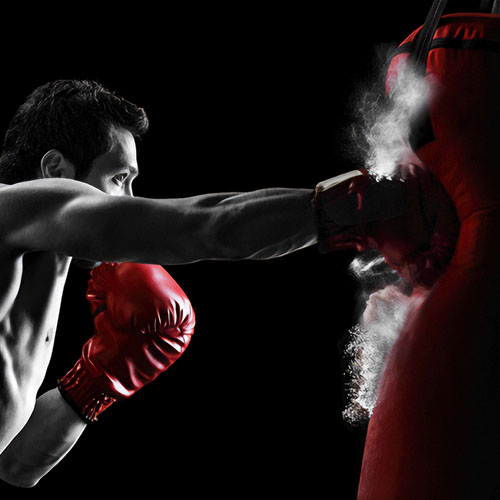
Extreme fighting lives up to its name as jailed athletes make international headlines and Native peoples prepare for battle.
The Battle for Battlecade
It was not a good weekend for Mitzi Jones. She had accompanied her boyfriend, Steve Nelson, to Montreal for Battlecade’s Extreme Fighting 2. There, on Friday night, April 26, Steve, a world-class sambo wrestler, had lost a decisive match in just 44 seconds to alleged martial-arts legend Ralph Gracie, the evening’s representative of Gracie Jiujitsu. Steve had openly been predicting he would beat Gracie, so the early demise was a humbling experience.
Earlier, there had been the threat of a shutdown of the event by the Sûreté du Québec, the provincial police, supposedly because the fighting would be too violent. But two days before the show the on-site promoter, along with three other representatives of the Kahnawake (pronounced gan-a-WAH-gay) Mohawks, in whose territory a half-hour drive from Montreal the matches were to be held, said they’d been assured by Minister of Public Security Robert Perreault at a meeting in Quebec City that there would be no interference.
On Saturday night, 24 hours after Extreme Fighting 2, Steve and Mitzi were quietly lying in bed together, naked, watching television in their Montreal hotel room, waiting to return home to Amarillo, Texas.
Suddenly the door opened and in walked a batch of five or six men. They announced that Nelson was being placed under arrest for participating in an “illegal prizefight.” Steve and Mitzi were ordered out of bed. Mitzi asked that the men step out so she could get dressed. The all-male posse refused, and ordered her to get dressed then and there in front of them. Later a tearful Mitzi would call this “a nightmare.”
Bienvenue à Québec.
Steve Nelson was one of eight people—the others being fighters Igor Zinoviev, Steve Falkner, Jim Teachout, and Marcus “Conan” Silveira, matchmaker and television announcer John Perretti, referee John Donehue, and even ring announcer Scott Berlinger—who were arrested that night or the next day by a combined force of the Sûreté du Québec and the Kahnawake Peacekeepers (P.K.’s). The detainees were promptly dubbed the “Extreme Fighting Eight” by Battlecade executive producer Donald Zuckerman.
The charge against each was a minor one in Canada—a “summary conviction,” approximately equivalent to a misdemeanor in U.S. law, usually confined to the issuing of a summons, with no arrest. The reason for the arrests, according to Joseph Montour, then chief of the Kahnawake Peacekeepers, was that since all the men were non-Canadians, they might flee the country. That meant that for a charge that Montour described as “like a traffic ticket,” they had to spend two nights in a foreign jail cell. They could easily have been bailed out, except that this was Saturday night and there was no justice of the peace available until Monday. In Quebec they are very devout and don’t work on Sunday. Never mind that many prison guards let it be known that they had attended the fights, had enjoyed them, and thought the arrests were wrong. Never mind that on this minor charge the Extreme Fighting Eight were penned up next to alleged drug dealers, armed robbers, and gangsters. The steel doors had clanged shut.
By Monday anger swelled throughout the Montreal area, with this story dominating the headlines. Many who had come for the bouts on Friday stayed over until the Monday bail hearing. Donald Zuckerman’s hotel suite became a war room.
The mood among those supporting the fighters was like that of the civil-rights struggle of an earlier era. When I told Donald that I was a veteran of student strikes at Columbia University he said, “Then you know, you’ve been through this before.” The war zone also began to take on the appearance of a movement office, with pizza boxes, half-eaten sandwiches, and soda bottles vying for space with phones, computers, and scraps of notepaper. People were tripping over the tangle of phone wires and unplugging the phones; I did what I could to re-install some of them. We were developing a sense of purpose that bound us together. Many of us had barely slept since the Saturday-night bust, and were looking forward to getting the hell out of there.
On Monday dozens of us went along to Superior Court in the Montreal suburb of Longueuil. As we sat in the courthouse coffee shop waiting for the wheels of injustice to creak forward, a well-behaved group of Kahnawake youths, mostly from the First Nations Tae Kwon Do Association school, walked into the restaurant. Would that more teenagers were as polite and orderly. Wearing their Kahnawake jackets, they had come to show support for those arrested. Since nothing was happening, they just wanted to sit, relax, and snack. Before they could order, a Quebec cop with a radio came into the coffee shop and threw out all these young people. Just like that. They left as they came, quietly.
Phyllis Lee, an American who is business manager for Battlecade fighters Igor Zinoviev, John Lewis, and Jim Teachout, came over to me and said, “I’m shocked.” Phyllis is no wuss. Thirty years ago she started out as a professional lady wrestler, and today she manages many fighters and wrestlers. She has seen and done it all, but now her jaw dropped. “They chased those kids out like blacks in the old South. That’s inhumane.” Vic Thériault, an Acadian who also co-promoted the show, shook his head and said, “It’s sad.”
But longtime Kahnawake activist Dale Dione was not shocked. “This is always how they treat our people,” she said. She sees a parallel between the treatment of the Native Canadians and that of blacks under apartheid in South Africa. Apartheid’s architects even came to Canada, she added, to get tips on how to set up Native “reserves.” The Canadian and Quebec police forces are “fascist and racist,” she matter-of-factly averred.
I had originally come to Montreal just to cover Extreme Fighting 2 for WBAI/Pacifica Radio in New York. Now I was in the midst of a sharp political struggle with all the rhetoric and fury of the sixties. The name “Extreme Fighting” even took on an unforeseen dual significance, the crux of the argument for its legality geared directly to the Kahnawake people’s claim that they had the right and authority under Canadian law to sanction sporting events on their own soil. So the battle for Battlecade and the Mohawks’ struggle for self-determination had become inseparable.
The jurisdictional background is clear enough. Canada’s Indian Act sanctioned the establishment of the Mohawk Council of Kahnawake, also called a band council. While its powers are quite limited, it is considered to be part of the Canadian government. Indeed, there are those in Kahnawake who have criticized it and even reject its authority, believing it to be too compromised. One power the council does have is to sanction sporting events. To this end, a three-person Mohawk Athletic Commission was set up under Article 81, Section M, of the Indian Act shortly before Extreme Fighting 2. Its members are Chief Phillip R. Jacobs, head of public security for the Mohawk Council of Kahnawake; Alwyn Morris, a 1984 Olympic gold and bronze medalist in canoeing; and, from the band council, Lindsay Leborgne.
Other fighting events, including some “toughman” competitions and bare-knuckled fights just two days before Battlecade, encountered no threats of shutdown. When on-site promoter Mike Thomas and the other three Mohawk leaders were assured at their meeting with Public-Security Minister Robert Perreault and Minister for Native Affairs Guy Chevrette that there would be no interference with the event by the Quebec government, they took them at their word and made a public announcement that the event would go on as planned. The Mohawk Athletic Commission sanctioned Extreme Fighting 2. Since the M.A.C. has jurisdiction in Kahnawake, the fights were legal. Mike Thomas of First Nations Productions made this clear when I interviewed him just before the scheduled bill. So did Chief Jacobs, who was also at the meeting with Perreault and Chevrette, emphasizing that the Mohawks were told “there would be no political or legal interference with this event.”
Fair is fair and the law is the law. Chief Jacobs says, “They did lie to us, there’s no question about that.” The Quebec officials, he says, “couldn’t take it that Mohawks did something without asking their permission.” So these white men lied and broke yet another agreement with the Native people. Kenneth Deer, editor of The Eastern Door, the Kahnawake community’s weekly newspaper, said there was a lot of political pressure on the Parti Québécois government from the opposition Liberal Party. “To save face they had to do something,” Deer stated, and the way they did it “showed a lack of confidence in the P.K.’s.”
“I’m sick of this shit,” said Mike Thomas. “If they want to fight, I’m ready. This is consistent with the way they deal with the Native people.” The reasons for the government’s actions, he says, were “dollars and flexing muscle.” Thomas charges both the federal and provincial governments with imposing “an economic embargo on us.”
A key issue is taxes. Federal and provincial taxes are usually not collected by the businesses in Kahnawake, often small family operations run out of the front of people’s homes. Many in Kahnawake do not recognize the authority of these governments over their lands; they consider themselves to be colonized by Canada and Quebec. Small businesses like gas stations often have their licenses pulled. Major businesses like casinos, which would compete with those in Montreal, are not allowed in Kahnawake. Empty storefronts and “Going Out of Business” signs confront a visitor to Kahnawake on all sides, confirmation of the economic plight of these still-proud people.
And so, directly from New York, in comes Battlecade—beyond the reach of the tax collectors. And just as with many other proposed money-making enterprises, the provincial government tries to either stall or stop it.
It’s ironic, said Mike Thomas, that Battlecade “is doing far more for the Mohawks than the S.O.B.’s in the government.”
The box-office take from Extreme Fighting 2, and contributions from the promoters themselves, were to go in part for a building for the Tae Kwon Do school, for the Kahnawake hockey program, for the North American Indigenous Games (a Native peoples’ version of the Olympics), and for boxing. Now all this is in jeopardy. “Who is hurt the most?” Thomas asked, and answered his own question: “The youth of Kahnawake.”
It is ironic, he said, that “an American corporation [Battlecade, Inc.] is doing far more for the Mohawks than the S.O.B.’s in the government, who have given not one cent for youth programs,” and have “done nothing but create problems for this whole country.”
The passionate approval of Battlecade is echoed in almost every section of the Kahnawake community. “It put us on the map,” said Dale Dione, who helps run the Kahnawake Amateur Boxing Club. She’s also a spokesperson for the People of the Longhouse, the ruling body of the Mohawks, which goes back many, many centuries; she does not recognize the band council’s legitimacy. “We are Mohawk citizens,” she added. There are seven communities in the Mohawk Nation that straddles the border between the U.S. and Canada, and “we do not recognize that border; … we look [upon] ourselves as a sovereign nation.”
Mohawks who share her views formed a united front with the band council in enthusiastically supporting Battlecade. It would “help us economically and politically,” Dione said. “Maybe it would be an impetus for other people to help us become economically stable. This is an opportunity for a worldwide major event to introduce to the world who we are.” The arrest of the Battlecade participants was “to prevent anybody from coming to do business in Kahnawake.”
While some in the media snicker at the fans of Extreme Fighting and seem to have a cultural or aesthetic problem with even allowing it to exist, Dione does not. She sees it as sharing key elements of the rich heritage of the Native people. “Fighting is part of our culture,” she declares. “We have to maintain the fighting spirit for our culture and our nation’s survival. We have to know how to fight physically as well as mentally.” That is why she works with the amateur boxing program. In Kahnawake there is also that successful Tae Kwon Do school run by Mike Thomas. The high-school wrestling team at the Kahnawake Survival School has for seven years won the Greater Montreal Athletic Association’s championship, even though the school has one of the smallest enrollments in the region. These sports, Dione believes, foster discipline. Battlecade brings “role models in … discipline” to Kahnawake. “Seeing people of the highest level of martial-arts discipline is very rare for young people here.”
But what about the bugaboo of Extreme Fighting’s supposed violence? Dione said a lacrosse game she had recently witnessed was “more brutal than what I saw [in the ring] on Friday night.” Chief Jacobs compares Battlecade favorably with pro wrestling. “The [World Wrestling Federation] for me is violent,” he says. Battlecade is “very well controlled and contained.” The nervous-nellyism is “overkill on this whole thing.”
What was the toll at Extreme Fighting 2? Carl Franks, who lost by a T.K.O. to Conan in 1:17, had six stitches, and was at the party right after the fights, socializing with everyone. Jim Teachout had a black eye, which he says was gone in two days. John Lewis had a small cut on his ear, probably from rolling on the mat. Even Perreault was quoted as saying, “As minister of public security, I am relieved the [anticipated] carnage did not take place.”
There was one Mohawk who did take action against Battlecade. That was Police Chief Joe Montour of the P.K.’s. As I stood in the lobby of Montreal’s Hôtel du Parc that Saturday night and watched the Sûreté, the P.K.’s, and hotel security bring one man (and Mitzi Jones) downstairs after another, I felt I was in a scene right out of Casablanca. I asked Montour if Grand Chief Joe Norton or the band council was aware of the raid or the arrests; he said they were not. He didn’t make the laws, he said, he just enforced them.
Two days later, on Monday, the band council suspended Montour without pay, pending an investigation, for disobedience. It also put on hold a policing agreement with Quebec and Ottawa that would have recognized the P.K.’s as the official police force in Kahnawake. Mike Thomas said that since the P.K.’s helped conduct the arrests, it showed they were “a Mohawk provincial police, not peacekeepers at Kahnawake.” The battle over Battlecade had aggravated the ongoing political crisis in Canada revolving around a fragile federal system, Quebec separatism, and the struggle of the Native people for sovereignty.
The show itself was harmed by all the government harassment. Four competitors were stopped at the border and not allowed into Canada. One of them, Denilson Maia from Brazil, a luta livre (free-fighting) standout, even had a visa specifically for the event. Another who was in Montreal left, fearing arrest. At the last minute matchmaker John Perretti had to juggle the lineup, and was suddenly left with no alternates.
The government worked to sabotage the production in other ways also. Quebec brought an injunction against Bell Canada to stop it from supplying a satellite uplink. A backup truck was called in from Portland, Maine. Just hours before showtime some 20 technical people walked out, fearing arrest. Producer Frank Belmont was stopped at the border and denied entry, so one individual was left to be producer, director, and camera switcher. Gary Dell’Abate from the Howard Stern show, who was supposed to be the ring announcer, was turned back. Scott Berlinger, who was supposed to be the roving reporter, now had to be the ring announcer. What was left was a skeleton crew. There could be no overhead shots, and there were fewer replays and post-fight interviews, along with other production problems.
Overall, Extreme Fighting 2 got largely negative reactions from fans who watched it on American television and had something to say in publications and on the Internet. Those who commented in Dave Meltzer’s Wrestling Observer Newsletter, which gives extensive coverage to these events as well as to pro wrestling, complained about the matchmaking, the quality of the fighters, the lack of a tournament, and the production.
All this led John Perretti to issue the following apology, which was posted on the Extreme Fighting 2 page on the World Wide Web: “All of us at Battlecade apologize to you, the fan, for a show that did not meet our own standards of excellence.” Donald Zuckerman issued a similar statement.
It should be noted that the crowd at the Kahnawake Sports Complex by and large seemed to enjoy the live show. Only the first, non-televised match drew any real boos. The crowd gave its loudest roar for Ralph Gracie, showing knowledgeability about who’s who in the Extreme Fighting world.
The whole ordeal of the days leading up to the show, what went on backstage and behind the scenes, and the political struggle were documented for German television by a crew headed by Tommy Sowards of Nuclear Picnic.
With all the high drama and tension, there were some lighter moments. Ralph Gracie was on the arrest list, but was never served by the police at the hotel. As he and his wife climbed into a car to appear in court on Monday, he gave the extended-thumb-and-pinkie “hang loose” sign, a surfer thing I told. Sowards also got some very private and revealing footage of the Penthouse Pets in their dressing room backstage at the arena.
In the end this long weekend became a classic struggle for human rights, for the rights of Native sovereignty, for the right to watch whatever sport we like, and for the right to make a living as a fighter. The hypocrisy of those who have for so long abused so many of our rights hiding behind a pretense of being outraged by “violence,” after their governments massacred and stole land from generations of Native people, is not funny, but scary. They dragged out one Big Lie after another, like calling Battlecade “human cockfighting” without knowing or caring just what it was about. Two days after the event the Montreal Gazette still “reported” that “[t]here are no referee-imposed technical knockouts,” even though two of the seven fights were stopped by the ref, and this has always been specified in the rules. To whoever was demeaned in the process, tough luck.
The issues transcend whether or not Extreme Fighting is one’s cup of tea. The future of this young sport is far from certain. Will the demagogues and censors prevail? That depends a lot on how those who still value freedom react.
Fast-forward forty years, and we’re staging MMA fights on the White House lawn. … We have no idea what insights to draw or lessons to learn from that fact, of course, since mostly we highlight things much moreso than be judgemental about them. That makes for much more pleasant team meetings, in case you were curious. You can learn a bit about the evolution between then and now as well if you find yourself more curious about the topic today than our