Our courts are run by too many judges who are corrupt, biased, or stupid (or, sometimes, all three).
Playing Politics with Justice
It was, to all appearances, one of those typical social conclaves of the New York legal establishment. As befits this very powerful group, the more than 200 attendees at the cocktail reception in one of Manhattan’s most exclusive private clubs mingled and chatted quietly under the crystal chandeliers and carved-wood ceiling. The atmosphere was luxurious, discreet, and almost magisterial — not surprising, since many of the guests were federal or state judges, there to celebrate the publication of a book by one of their colleagues. But there was an air of uneasiness lurking over the affair. As everyone in attendance well knew, these are rough times for judges. Public esteem for the judiciary — once among the most respected professions in the United States — has hit a new low.
The judges have brought this crisis of public confidence on themselves, for too many of them, including some of the people in that very room, have proved to be either incompetent, corrupt, or ideologically obsessed.
Hardly a day goes by without news of some new controversy set off by still more courtroom lunacy. Indeed, while the judges at the cocktail reception sipped white wine and nibbled hors d’oeuvres, outside there was a public fury in full flame, ignited by the latest judicial outrage. One of their fellow jurists, in an unbelievable decision a few days before that had sent shock waves all the way to the White House, threw out the evidence in a New York City drug case on the grounds that police had no reasonable cause to search a car merely because four men who were stuffing something into the trunk fled when they spotted two cops. (The trunk was found to contain 36 kilos of cocaine and heroin.) The judge went on to say that such flight was understandable because in the neighborhood in which the incident took place the police were perceived to be corrupt.
Because the defendant’s wife was having an affair, the judge literally gave him a slap on the wrist for severely beating her.
The decision, if it can be dignified with that term, had particularly upset the evening’s featured speaker, then New York City Police Commissioner William Bratton. Nationally renowned for rehabilitating a moribund police force, the country’s largest, and then sharply reducing the city’s crime rate, the Boston-bred Bratton strode to the podium with the fuck-you assurance of a man with a $350,000 book contact in his pocket and a guarantee of six-figure income in the private sector once his tour of duty was over (which occurred only two weeks later). Bratton’s circumstances meant he didn’t have to please anybody, and the commissioner spoke his mind. Put simply, he thought most of his audience were a bunch of jerks. While they squirmed, Bratton called some of them “screwballs” who were creating “phenomenal burdens for our people.” These judges, Bratton snapped, were not “living in the streets of New York City … they’re living in a Disneyland.”
It went downhill from there, and by the time Bratton was finished a smattering of polite applause could not conceal the shock of the nation’s most noted law-enforcement figure criticizing judges to their faces in works that would have earned him a contempt citation if he had uttered them in a courtroom.
It is difficult to imagine such bluntness taking place anytime in the past, when judges — despite a few bad apples — still enjoyed widespread public respect. By virtue of their title (Your Honor), dress (solemn black robes), and elevated function (interpreting the laws), the judges of America were for a long time on a pedestal. In part that was backed up by the Constitution, which accords them virtual immunity from the crossfire of politics and public controversies. Federal judges are by law generally protected from suits for judicial acts “within or in excess of their jurisdiction,” even if such acts have been committed maliciously or corruptly. They are appointed for life, and can only be removed by congressional impeachment for “high crimes and misdemeanors.” State and local judges are either selected or elected to long terms and are protected by a system that makes their removal difficult or nearly impossible, in order to insulate them from political pressure. In either jurisdiction, judges are rewarded with six-figure salaries and batteries of assistants to handle onerous chores, and are accorded near-dictorial powers within their courtrooms. Their impact on American life is enormous.
But they are not exempt from public criticism, and Bratton’s tough words reflected the conviction by growing numbers of citizens that there is something very wrong with a system that seems increasingly out of touch with the realities of public confidence: A 40-percent increase during one three-year period in the number of complaints lodged against federal judges; the sudden flowering throughout the country of dozens of grass-roots judicial-reform campaigns, among them a voter initiative in California that would totally overhaul the state’s judicial-accountability laws to make it easier to get rid of bad judges; proposed legislation in New York that would toughen criminal laws and in the future forestall rulings like a series of those by the state’s highest court that have granted criminal defendants rights far beyond those sanctioned by the U.S. Supreme Court; sharp increases across the country in complaints against state judges (in Arkansas, nearly half of all complaints about the justice system now concern injudicious temperament by judges).
To be sure, given the country’s surging crime problem and increased litigiousness, the judicial system is under strain. Justice is a growth business (the increase in the number of people employed in criminal justice has far out-stripped population growth, jumping from 320,000 to 1,650,000 in the past 30 years), and caseloads in the federal district courts have tripled in the past three decades, to a current level of more than 280,000 cases each year. The burden in the state courts is even higher, with state judges now routinely handling up to 175 cases at a time.
Nevertheless the pressure caused by this explosion does not fully explain why a Philadelphia judge threw a glass of water at a lawyer; why a Washington judge told on defendant, “Shut up before you go to jail”; why a Los Angeles judge told a witness, “I am God”; why a federal judge in California routinely castigates women and minorities and calls environmentalists “pointy-heads”; why a Maryland judge in open court termed the case of a man accused of raping an 18-year-old woman who had passed out on a bed “the dream of a lot of males.”
No, the answer lies, deeper, in the kind of people who are selected to become judges. The truth is that the quality of selectess has been declining steadily the past two decades. As a result the nation’s benches are filled with a growing percentage of judges who are either corrupt, ideologically biased, or stupid (or, once in a while, all three).
Of all these sins the one that most causes public dismay is ideological bias. As Americans have learned, there are too many judges from both the right and left ends of the political spectrum who are determined to rewrite the law — and the U.S. Constitution — rather than uphold it. They are intent on imposing their own social agenda in an arena supposedly exempt from politics. Most often, their impact is on criminal law, and such activism has created an entire library of judicial horror stories. Among them:
- Judges on a District of Columbia appeals court much obsessed with broadening the rights of criminal defendants threw out a murder conviction because, although the police had read the accused his rights, he had not been readvised of those same rights when he later confessed to a detective who was a friend of his family. Tellingly, the court’s decision did not even mention the victim’s name.
- Charges against a man accused of shooting a police officer were dismissed by a Florida appeals-court judge because the instrucions to the jury had contained several technical errors having nothing to do with the actual charges.
- A federal judge in New Jersey, to the fury of the local community, ruled that a mentally disturbed homeless man could not be removed from the public library despite his disruptive behavior, his use of the facility as a flophouse, and his tendency to stink up the place. To make matters worse the judge lectured local residents for “narrowness” and violating the homeless man’s “First Amendment rights.”
- A New York judge threw out evidence against a rape suspect that police had obtained with a search warrant because police served the warrant at 5:30 P.M. — which the judge found violated the warrant’s restriction that it be served only during “daylight hours.”
- A Michigan judge literally gave a slap on the wrist to a defendant who’d been accused of severely beating his wife, an action His Honor explained that the punishment was appropriate because the man’s wife was having an extramarital affair.
- A Florida judge gave custody of an 11-year-old girl in a divorce case to her father, a convicted murderer. The mother’s plea for custody was rejected, the judge said, because she is a lesbian.
- New York’s Court of Appeals, the state’s highest court, threw out the conviction of a drug dealer who was caught with 38 vials of crack in his pockets on the grounds that police had no “reasonable cause” to search the man’s pockets — despite the fact that he was in a known drug-dealing area, had strange bulges all over his body, and was witnessed actually selling the drugs he removed from his pockets.
These kinds of decisions, argues Mary Ann Glendon, a Harvard Law School professor, are the inevitable result of a trend that began in the late 1960s, when a new and romantic ideal of activist judges came into being. The idea was that judges, whose traditional role was to maintain the delicate balance between the needs of society and individual rights, must use their power primarily to effect social change. The new model judge was to exercise compassion rather than impartiality, boldness instead of restraint, creativity instead of craftmanship, and to achieve specific, political goals regardless of their effect on legal order as a whole. As District of Columbia Superior Court Judge Sylvia Bacon, herself a self-described activist judge, summarized it: “There is a sense among judges that there are wrongs to be righted and that it is their responsibility to do it.” (In fact the Constitution makes it clear that this function is reserved for the legislative branch.)
In other words a highly politicized judiciary, for such judges will be selected on the basis of political activism rather than legal scholarship. No better example of this tendency exists than a federal judge named Harold Baer, Jr., whose decision in a New York narcotics case so inuriated Commissioner Bratton and many other Americans.
How he came a judge reveals much about how the system works — and why we get so many bad judges.
The story begins in 1993, when Congress, reacting to increased court caseloads in the federal system, authorized the creation of new judgeships, including 15 for three New York judicial districts that serve nearly 20 million people. This immediately set off intense and extensive maneuvering within political power centers, for judgeships have come to be regarded as prime political plums.
The way the system is supposed to work is that each state’s U.S. senators ask their state bar association for the names of worthy nominees. Those names are submitted to screening committees, where they are rated as “qualified” (not too bad), “highly qualified” (likely to make fine jurists, the highest possible rating), or “not qualified.” The senators — who are free to ignore the recommendations — then select nominees from this list or elsewhere and forward them to the President, who has usually agreed in advance to accept the senators’ candidates. He then submits the candidates to the Senate, where the Judiciary Committee investigates them and reports to the full Senate, which approves or disapproves.
In reality that’s not how things work these days. “The process is strictly political, from beginning to end,” says Ruth Sassower, head of the Center for Judicial Accountability, a New York grass-roots organization that has been trying to reform the judicial-nomination process. “A nominee is selected because he or she has political connections. Politicians decide who gets nominated. They trade judgeships like baseball cards. Essentially, the Republicans and Democrats divvy up judgeships; you give me two judgeships and I’ll give you two.”
The process that brought Baer to the federal bench illustrates Sassower’s point perfectly. Although New York’s senate delegation is split between Democrat Daniel Patrick Moynihan and Republican Alfonse D’Amato, there is no partisan bickering over judicial appointments. In 1993, D’Amato and Moynihan, needing candidates for two new judgeships created for the Southern District of the state — primarily Manhattan and neighboring counties — came to an arrangement. It called for D’Amato to pay off a political debt by nominating a Republican hack from suburban Westchester County whose principal qualifications for the job seemed to be that he was a hard-line law-and-order conservative and, much more important, had served as county campaign manager for George Bush in 1988. Bush had won a huge plurality in that race, a turnout that also strengthened D’Amato’s position in the state Republican organization. The nominee’s legal qualifications for the post consisted of his role in a grand total of three minor civil cases during a brief and undistinguished legal career.
The process of selecting judges “is strictly political, from beginning to end,” says one legal expert.
In exchange for his support of this nonentity, Moynihan got D’Amato’s approval to pay off his own political debt by nominating for the federal bench a state judge named Harold Baer, Jr., who had won his job on the state bench in 1984 as part if a bipartisan reciprocal-endorsement deal.
The son of one of the founders of the Liberal Party in New York, Baer had been a party activist, no small matter in New York Democratic politics. The Liberal Party, which is nominally to left of the state’s Democrats, is an important third force in state electoral politics, and often has played a decisive role in tight primaries. In general elections its line on ballots is avidly sought by Democrats, and the party can play an important role in any election with multiple candidates. Among the beneficiaries of Liberal Party support had been Danie; Patrick Moynihan.
So for one of the most important federal legal jurisdictions in the United States the process had produced two nominees — a nonentity and a political activist, neither of those legal backgrounds was especially impressive. But the two candidates sailed right through the screening committees of various bar associations, raising the question of whether anyone was paying attention.
“Of course they were,” says one lawyer involved in the process. “What they were aware of was that these two clowns came with heavy political baggage, and that’s what counts. Believe me, the bar associations are just are politicized as anything else. The screening is a joke; what really happens is that the people supposedly doing the screening talk to a few people and find out if the nominee has ever molested little children or tried to blow up the World Trade Center. If not, they’re in, because that’s the deal. A lot of these people are looking for judgeships someday themselves, and if the Republican or Democratic honchos say this is or, nominee, you better believe the lawyers aren’t going to queer their own future prospects by blackballing anybody.”
In April 1994, Baer’s name was formally submitted to the White House as nominee for the federal district court. There, the nomination was rubberstamped, since Moynihan is a powerful Senate Democrat whose seat on the Budget Committee — among other things — made the White House eager to please him. Baer passed that hurdle easily, having fulfilled two minor requirements: a six-page questionnaire on his background that apparently nobody read, and a financial-disclosure form, also unread.
Baer’s nomination, one of 185 Clinton has made since taking office, was sent over to the Senate. It landed in the Judiciary Committee, whose chairman, Republican Senator Orrin Hatch, has often fulminated against the President’s choices for the federal bench, which he said proved that Clinton was “soft on criminals.” Hatch has also said, “President Clinton talks about cops on the beat. Yet he appoints some judges who are too willing to put criminals back on the street.”
This kind of political rhetoric might sound impressive, except Hatch forgot to mention that he himself had formally opposed only two of Clinton’s 185 judicial nominees, neither one of them Baer — who was approved without any hearings by Hatch’s committee, or a debate on the floor of the Senate, or a roll-call vote. Baer was among several dozen judicial nominations dropped onto a desk in the Senate chamber late on the day before an August recess when only a few senators were present. Then Senate Majority Leader Robert Dole didn’t ask for a roll-call vote or any debate on a single Clinton nominee. They were approved en bloc.
The reason for this rubber-stamp approach was, of course, more politics. The Republicans can fulminate all they want to, but the truth is that behind the scenes they and the White House have been quietly horse-trading judicial nominations, among them a deal that gave the Democrats several female nominees in exchange for a strongly pro-death-penalty candidate the Republicans wanted for an appeals-court post out West. And when Hatch raised hell about Clinton’s proposal to name to an appeals-court seat Peter Edelman — the husband of Hilary Clinton’s good friend Marian Wright Edelman and a super liberal who has floated the idea of judges ordering cash payments to poor people even if neither Congress nor the voters want it — a deal was worked out. Clinton withdrew Edelman’s nomination and proposed him for a lesser District of Columbia district-court post with the blessing of Hatch, who was promised White House support for one of his own conservative judicial nominees.
Clinton has brokered a number of such deals with a Republican-controlled Congress as a way to win congressional approval for some of the nominees the liberals of his party wanted. In addition to Baer. the people of New York state were rewarded with a new federal judge named Shira Scheindlin, one of whose first decisions was to protect New Yorkers from dope dealers by sentencing one, convicted in a case involving 12 kilos of cocaine, to a mere 18 months in prison — in defiance of federal guidelines that call for a ten-year prison sentence. To explain why she threw out a resisting-arrest charge, she unbelievably ruled that the suspect’s attempt to wrestle away the arresting officer’s guna and flee “evidence[d] a perfectly reasonable fear of consequences.”
Bartering judgeships reached an apex of sorts during the Reagan and Bush administrations, when elaborate machinery was set up in the White House and Justice Department to assess candidates for political purity, rather than legal qualifications. The most notoriously bad judge to come out of that process was Daniel A Manion, a dim-witted right-wing of the Republican Party as the ideal man to “de-liberalize” the federal courts. Noted for his ignorance of the law and inability to spell, Manion was fiercely opposed by Democrats. But he won approval when two Democratic senators who vowed to defeat him suddenly switched their votes in a deal with the Reagan White House that gave them several of their own nominees.
No such political free-for-all marked Harold Baer’s ascent. Without fanfare he took up his duties in the early fall of 1994. Aware that almost none of the people picked for the federal judiciary these days are selected for their legal brilliance or scholarship, the federal judiciary these days are selected for their legal brilliance or scholarship, the federal court system put Baer, as it does all new judges, through a few cram courses on federal law and procedures. Most of the heavy thinking is done by the three law clerks assigned each judge.
Baer labored in relative obscurity until January 26, 1996, when he presided over what federal prosecutors assumed, not unreasonably, was the legal equivalent of a slam dunk. Officially, the matter on the day’s calendar was an evidentiary hearing on a routine defense motion seeking to quash the compelling evidence against defendant Carol Bayless, who was facing trial on interstate narcotics-trafficking charges. She was looking at a minimum of ten years in jail if convicted.
According to the prosecution, Bayless had been spotted at 5 A.M. on April 21, 1995, by two New York City police detectives. They said she was slowly driving a red Caprice in Washington Heights in Upper Manhattan, an area plagued by drug dealers. As she double-parked the car, which bore Michigan license plates, four men materialized and opened its trunk to stuff several duffel bags inside. It had all the the earmarks of a drug deal, and as the suspicious cops approached, the four men fled.
Certainly there was enough “reasonable cause” for the cops to dig deeper, and when they did they struck pay dirt. Bayless, they later testified, had a large pile of cash lying beside her on the front seat, and could offer no reasonable explanation of why she had driven all the way from Detroit, her hometown, to for a major drug ring headed by by her son. She said she made regular runs to New York to buy narcotics wholesale for sale in Detroit, and was to get a fee of $20,000 for this particular run.
She was taken to the local precinct, where she gave a videotaped confession in which she said that during the past four years she had made 20 Detroit-to-New York drug runs, and that she had about $1 million with her to buy drugs. She was not contrite. “I was a little naive,” she said in her confession. “I didn’t look at it like me purchasing [narcotics]. It was like, me, I was just driving … My concerns were for the money, that’s all.”
Seemingly an open-and-shut case. Bayless’s court-appointed lawyer, Ramon Pagan, didn’t have much to work with, so he moved to exclude the evidence, arguing that the cops had no reasonable cause to check out Bayless’s car, notwithstanding the four fleeing men. Moreover, he announced, his client was now repudiating her confession.
Not a convincing argument — except that Baer bought it. To the shock of prosecutors he not only threw out hte evidence of the drugs found in the car, he also suppressed Bayless’s confession on the ground that he found her new version of events more convincing than the testimony of police, whom he all but accused of being liars. Then Baer went on to say that police were wrong to regard four men fleeing from a parked car as suspicious in any way. “Residents in this neighborhood,” he said, “[tend] to regard police officers as corrupt, abusive, and violent. Had the men not run when the police began to stare at them, it would have been unusual.”
Baer topped this analysis of police-community relations with an even more bizarre foray into sociology. “What I find shattering,” he said, “us that in this day and age, blacks in black neighborhoods and blacks in white neighborhoods can count on little security for their person[s].” How Baer divined this was hard to figure, since he doesn’t live in an inner-city neighborhood (his residence is a luxury co-op in mid-Manhattan). In any event, he was wrong.
For one thing, the area of Washington Heights where the incident took place is not a typical “black neighborhood,” nut is in fact populated in large part by Dominican immigrants. Second, people in that hard-working community do not routinely run away when they see cops (although bad people do). Third, there was an extensive police-community operation under way in that area to clean out drug dealers. The operation was proving very successful, and grateful citizens had named a local Little League field in honor of a police officer who had been killed by a drug dealer.
Baer’s decision set off an explosion. Commissioner Bratton publicly called him “crazy.”A parade of politicians followed Bratton, and the matter reached Washington. Newt Gingrich thundered that Baer had a “pro-drug-dealing, pro-crime, anti-police, and anti-law enforcement attitude.” Some 150 members of Congress, mostly Republicans, signed a letter to President Clinton asking him to demand Baer’s resignation. Even The New York Times, hardly the voice of conservatism, called Baer’s decision “judicial malpractice.”
Clinton, who had nominated Baer, was confronted with trouble in an election year. He handled it characteristically, first issuing an extraordinary statement saying he might seek Baer’s resignation if the judge did not reverse his decision, then announcing he would not ask for such a reversal after all, but would let the matter be argued in court.
Clinton’s retreat was in response to a furious counterattack by the legal establishment, which had circled the wagons around Baer. Judges, said Chief Judge Judith S. Kaye of New York’s Court of Appeals, “must know their decisions … will not be subject to a kind of second-guessing” (an assertion that raises the question of why appeals courts exist). And Barbara Paul Robinson of the New York City Bar Association, which had deemed Baer “very qualified” when his name was first proposed for a federal judgeship, warned, “No judge should worry that a politically unpalatable decision could lead to removal.”
Interestingly, among the critics of Baer was none other than Senator Moynihan, who said the judge’s decision was “disqualifying,” and added disingenuously that if he had known of Baer’s view of the police, he never would have nominated him. The fact is that Baer had not been on anybody’s short list for a federal judgeship when the new vacancies opened up. As Moynihan had to know, by consensus that list was headed by New York State Supreme Court Justice Harold J. Rothwax, among the most talented and respected jurists in the country. But Rothwax, a persistent critic of the judicial system, is detested by politicians because he is not an ideologue of any stripe and has never made a secret of his contempt for politicos. Further disqualifying him was an appearance he had made before a judicial nominating convention some months before, where he lambasted the legal establishment for failing to overhaul a system in which the public has lost all faith.
Most criminal trials are exercises in hair-splitting, leading people to believe the system is obsessed with defendants’ rights.
Moynihan’s failure to consider Rothwax was no isolated incident. Recently Moynihan submitted a nominee to fill a vacancy on the U.S. Court of Appeals. Nathan Lewin, a noted constitutional scholar, was widely regarded as the best man for the job. Like Rothwax, he is not a political ideologue, and that fact cost him the judgeship: Moynihan nominated the undistinguished but well-connected Chester Straub. What are Straub’s qualification? The lawyer is an important power broker in New York liberal Democratic circles and a law partner of former governor Mario Cuomo’s.
As for Moynihan’s other sterling judicial nominee, Harold Baer, the explosion that set off was still reverberating when the U.S.s Attorney’s office demanded a rehearing to present sufficient evidence to change Baer’s mind. At first, the judge sneeringly dismissed this effort as a “juvenile project,” but subsequently seemed to have got the message, for his tone changed dramatically a few weeks later. “The prospect remains,” he said, in granting the prosecution request, “that by way of rehearing the court may acquire valuable new evidence which bears directly on the central issue of credibility.”
Baer took that action despite an astounding public statement by four members of the Second Circuit Court of Appeals, who said criticism of Baer “threatens to weaken the constitutional structure of the nation.” Coming from the very court that would hear an appeal of Baer’s ruling, it signaled that that court might not be an objective arbiter.
This ethical lapse was subsumed by even more astonishing events in Baer’s courtroom. With six government prosecutors on hand — an extraordinarily large number for a court hearing — the prosecution once again laid out its evidence. Among those testifying was the accused herself, 41-year-old former factory worker Carol Bayless. The woman whom the judge had found more credible than the police now suddenly had become a liar in the eyes of the very same judge. “The government’s version is more credible,” Baer announced after rehearing the government’s evidence. In a highly unusual action, he then reversed his own ruling of four months earlier and subsequently removed himself from the case.
Politics or not, Baer’s reversal inspired a sigh of relief throughout the law-enforcement establishment. Under severe public pressure to do something about crime, it had been encountering problems in the courts, where a large number of judges routinely held prosecutors and police to evidentiary standards almost impossible to meet. Many trials have become the modern equivalent of medieval philosophy’s debate about how many angels can dance on the head of a pin, with whole libraries of case law devoted to tortuous mecroexaminations of the real meaning behind such phrases as “good-faith effort” and “reasonable cause” and “exclusionary rule.”
No one wants to go back to the bad old days when police routinely, and unconstitutionally, forced their way into suspects’ homes and tapped phones without warrants — a practice that did not end until the 1961 landmark U.S. Supreme Court case Mapp v. Ohio. (The New York City Police Department asked the courts for a grand total of three search warrants between 1896, when Teddy Roosevelt founded it, and 1961.) But the courts, both federal and state, have since made the rules so stringent that today most criminal trials are exercises in hair-splitting, a situation that has led to public perception of the justice system as being obsessed with the rights of criminal defendants at the expense of victims. Police academies now routinely include classes in mock trials, complete with furious cross-examinations involving the minutiae of evidence, an experience all cops will have to undergo at some point. (Some, unfortunately, learn the art of “testifying,” shading testimony to meet burdensome evidentiary standards.)
This problem is especially acute in some state courts, where activist judges have imposed nearly impossible roadblocks to convictions. New York State’s Court of Appeals, for example, composed entirely of very liberal judges appointed by Mario Cuomo during his 12 years in office, has become notorious for its operating theory that defendants need “special protection” beyond that required by the U.S. Supreme Court. Among its more outrageous decisions was the suppression of a confession by a man who had murdered his girlfriend by cutting her throat. The court said police failed to obtain a warrant before rushing into the man’s apartment to arrest him eyewitnesses told the cops he was hiding there. (The U.S. Supreme Court overturned that one.)
Men in New York are advised that they stand almost no chance in a family-court system dominated by radical feminist judges.
The same Court of Appeals also threw out the conviction of a farmer who was growing marijuana where his cornfield used to be. With the evidence in plain view, the cops seized the plants and arrested him. But the court said there was a “No Trespassing” sign on the property and that constituted an “invisible wall” the cops needed a search warrant to breach … although recent U.S. Supreme Court rulings have held otherwise. In its two latest rulings the New York appellate court threw out the convictions of a car thief and a drug dealer over highly technical violations of court procedure during their trials … in one case because the defendant did not give his written consent to the replacement of an ill juror with an alternate during his trial, even though he gave his verbal consent and the replacement had been urged by the defendant’s own lawyer.
California law calls for the election of state judges, and though some legal scholars have long argued that this unusual method of filling judgeships subjects members of the bench to political influence, it is beginning to look attractive to people fed up with junk justice. They blame judges for the mess, noting that while the judiciary is busy making life a nightmare for law enforcement, it is also entertaining (and accepting) a flood of so-called inmates’-rights suits from the nation’s prisons. The vast majority of these suits are frivolous, filed only because jailhouse lawyers have discovered that there are judges out there who will listen to them — suits over the right to use pink towels instead of white ones, the right to attend chapel services in the nude, the right to a salad at lunch, just to cite a few examples. In South Carolina a federal court ordered state prison authorities to provide an extensive recreation program for inmates, including croquet tournaments, badminton, and paddleball.
The idea of subjecting judges to the voting booth also looks attractive to the growing numbers of people who are dismayed by what is happening in some of the less-publicized courts around the nation, particularly the family courts. There is something of a ferment bubbling in these courts, caused mainly by a running way between a new generation of feminist judges and lawyers for male litigants, who complain of rampant “gender bias” against men. One Arizona lawyer publicly resigned from the local bar association after a series of rulings by judges who, he said, made no secret of their belief that all males were prima-facie guilty. In California an attorney courted judicial censure by publicly calling the state’s family-court system a “cesspool of … gender bias.” In New York a leading family-court practitioner says he advices all male litigant that they stand almost no chance in a court system dominated by what he calls radical feminist judges.
Only three federal judges have been impeached since 1936. Perhaps for that reason they tend to react vehemently when confronted with even the most minimal standards of accountability. Consider the experience of Senator Charles Crassley of Iowa, chairman of the Senate Judiciary Committee’s Subcommittee on the Courts — with responsibility for funding and deciding the number of federal sitting judges — when he sent out a questionnaire in 1995 to all federal judges seeking to determine their workload. From the reaction you would have thought he had asked for three pints of their blood. The judges protested furiously, some calling Grassley’s request a “witch-hunt” and others thundering that it amounted to “blatant constitutional meddling.”
Grassley was on the right track, for he had to look no further than 26 Federal Plaza in New York City, where taxpayers are footing the bill for a huge new courthouse to accommodate all the federal judges for New York’s Southern District, Harold Baer among them. The cost of the new building, still under construction, has soared to more than $120 million, thanks in part to the judges who will work there. They have insisted on a long list of amenities, including special carpeting at $114 a square yard, carved wooden doors at $9,000 each (adding $9 million to estimated costs), luxurious wood paneling (another $5 million), and a solid-brass $5,510 cabinet to house a fire hose.
New York is not alone. In Boston a $1.6-million floating dock was added to a new courthouse at the insistence of judges apparently concerned about having somewhere to tie up their boats. “I wish I could tell you there was some way of stopping this kind of craziness,” says one General Accounting Office investigator who first uncovered the cost overruns. “We tell Congress, but Congress doesn’t do anything. Nobody wants to take on a judge. That’s real power, I guess.”
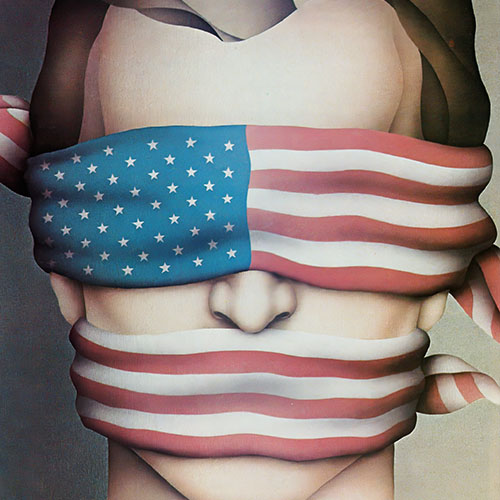
Illustration based off work by C.F. Payne
We have so many, many issues critical in the minds of many that it can be nearly impossible to keep track of them. Still, we must try, and some of us dedicated to the concepts of justice — no matter how one defines the outcome of that principle — find that keeping abreast of The Brennan Center could help. Be aware, though, that seeking justice may (hopefully) become a life-long quest. Keeping abreast, well, sometimes those are better in pairs.