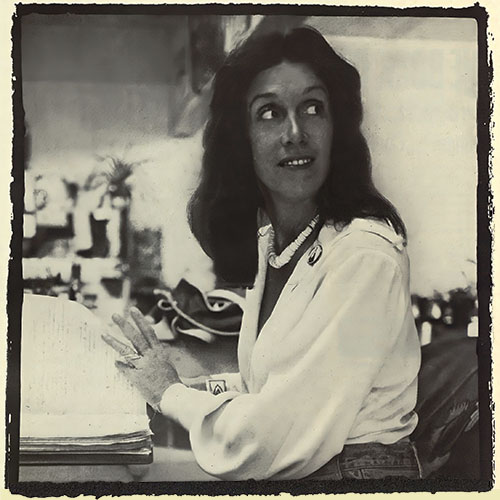
Given little chance to succeed when he first announced for race last June, Hayden has since surprised political observers by waging a vigorous and highly visible campaign.
The Tom Hayden Journey
Aside from the presidential sweepstakes, perhaps the most intriguing — and unorthodox — primary of 1976 is being contested in California, where former student activist Tom Hayden is attempting to wrest the Democratic nomination away from incumbent U.S. Senator John V. Tunney. Often accompanied by his wife, actress Jane Fonda, Hayden has been blanketing California with personal appearances, usually speaking before at least three groups a day. Financially, he has already done better than expected. His campaign has been fueled by such New Hollywood figures as Francis Ford Coppola and Michael Douglas, while rock stars Linda Ronstadt, Bonnie Raitt, and Jackson Browne have been among the pop performers to pitch in with benefit concerts. All of which helps explain Hayden’s steady rise in political polls. His prospects for victor no longer seem remote, a state of affairs that doesn’t particularly surprise Tom Hayden. “Our country has changed enormously since Watergate,” he says. “A few years ago, people like John Mitchell and John Ehrlichman wanted to throw people like me in jail. It now turns out that I get to run for the Senate — and they might wind up in prison instead.”
Hayden’s hopes for an upset rest on his underlying assumption that the radicalism of the 1960’s is fast becoming the political common sense of the 1970’s. He may have a point, for only a few years ago anyone who spoke out against such things as American military intervention, the CIA, the FBI, and the excessive power of big business was publicly labelled — as Hayden was — a wild-eyed radical. Today, the same views seem more those of a reformer than a revolutionary.
For Tom Hayden, times have indeed changed. A graduate of the University of Michigan, Hayden first attracted national attention in 1961, when he was beaten up during a freedom march in McComb, Mississippi, and later jailed in Georgia. After working in the South for two years as a civil-rights organizer, Hayden became a co-founder of Students for a Democratic Society. Almost from its inception, SOS-with an eventual membership of nearly one million college students-actively protested America’s military presence in Vietnam.
In the course of his antiwar activities, Hayden traveled to Southeast Asia four times, and in 1967 acted as intermediary in negotiations that resulted in the first release of American POW’s. A year later he led antiwar demonstrations at the Democratic National Convention, for which he was arrested and put on trial as one of the “Chicago Eight.” All the defendants were ultimately exonerated, and in 1970, Hayden became national coordinator of the Indochina Peace Campaign, a cause that occupied much of his time until last spring.
To interview the thirty-five-year-old senatorial hopeful, Penthouse sent free-lancer Lawrence Linderman to meet with Hayden during two of his recent swings through northern California. Reports Linderman, “In the sixties, Tom Hayden was said to be an icily detached political theorist, but if that was the case — and frankly, I doubt it — Hayden has clearly loosened up. Instead of an introverted ideologue, Hayden comes off more as an engaging Irish-American with a well-developed appreciation for ironic humor and a growing gift for political oratory. His aides told me that when the campaign began Hayden tended to be stiff and professorial in his speeches, but at one rally I attended in Sonoma he was effortlessly able to turn on a standing-room-only crowd consisting mostly of urban and political dropouts. A few weeks before, I’d seen him receive similar receptions at a convention of San Francisco’s Council of Democratic Clubs and at the annual officers’ meeting of a state employees’ union.”
“Hayden wants to run the most active campaign in recent California political history, and he seems to be doing it. His campaign also has a good deal of glamour going for it, much of it in the person of his wife. Whenever Jane Fonda is along, the crowds are larger, the photographers are more plentiful, and the media coverage is more extensive. Still, Hayden himself is a genuine draw, and it hasn’t been unusual for campus crowds of more than 3,000 people to show up at one of his speeches. The Tunney camp is particularly worried about Hayden’s growing collegiate following, for whenever he appears at a school, campus registrars inevitably sign up scores of first-time voters.”
“As this report was being filed, Hayden’s campaign was continuing to gather steam, but the smart money was still on Senator Tunney. What Hayden had to say about his own chances of pulling off an upset provided a logical opening for the first of our taped sessions.”
Although your senatorial campaign has attracted a good deal of interest and attention, most political observers predict you’ll fall short of victory. Are they wrong?
Hayden: They usually are wrong. aren’t they? Of course, when I first began exploring the idea of running last April, I also started with the assumption that I’d lose. At that point I was analyzing the value of entering a race I couldn’t win. One possible reason for doing so was that my campaign might have strong political impact, but I finally felt that such an argument wasn’t enough. Why spend a year running if all you can say is that you’re running to educate? There are other ways to educate, and besides, you can’t expect people to put their energy, money, and hopes behind someone who’s just there to educate.
But meanwhile, people I respect kept telling me to run. These were community-based activists who planned to work on the campaign, and whose judgments I trust. They felt I couId win it, so I spent the month of May exploring what my chances were of getting solid, grass-roots support, money, and a fair shake from the press. I was frankly surprised by how positive the indications were, and so I finally decided to run — but only because I thought I had a chance to win. I’m not running just so I can sweep Berkeley.
I’m still an underdog and a long shot, but I’m much more confident of my candidacy because of the gains we’ve made since I announced. The Field Poll, which is California’s most respected poll, reported that Tunney’s popularity among Democrats had dropped from 65 percent in early June to 55 percent in September, which was a real reflection of the organization and activity of our campaign. During the summer months I met with about 475 citizens’ groups all over the state. and I’ve kept up the pace since then.
Senator John V. Tunney is a good-looking, bright, articulate, middle-of-the-road politician. Won’t it be extremely difficult to dislodge such an incumbent?
Hayden: Let me answer you with our campaign slogan: It can be done. Our national disgust with politicians keeps growing, and as more information comes out about the hidden activities of the FBI, CIA, and multinational corporations, people will see even more clearly the unimpressive nature of the candidates they have to choose among this year. Tunney, because he is bland and a waffler, is not a villain, but he’s perfectly representative of what’s wrong with politicians.
Which is?
Hayden: They are essentially unreal. Politicians like Tunney hire high-priced advertising agencies to create a candidate image that voters supposedly are looking for. That image is then tested in voter samplings and finally sold to the public by purchasing television time and selling it the same way cars and detergents are sold. In the end, voters are asked to make up their minds and express a choice — but they can’t make a real choice, because they can’t ever find out what the candidate stands for. The best they can do is guess between images, and often these images all come from the same Madison Avenue firms. We do our own ads, incidentally.
Aren’t you making Senator Tunney sound a lot like the character Robert Redford played in The Candidate?
Hayden: No, because Tunney doesn’t have the roots of that film character — the guy Redford played at least started with the poor. Tunney is just a creation of advertising executives, who have become the key people in most campaigns. They aren’t the powers that be — advertising men don’t have great personal wealth — but they’re the technicians who work on behalf of candidates who serve the money powers. Advertising has by now become a game in which we try to see through what the seller is saying to find out what the truth is, because we never expect someone to tell us the truth about a product. It’s affected politics the same way. There are advertising agencies that promise to put you in office if you’ll agree to allow them to have complete control over what you say, how you appear, and where you go — your entire campaign. The result is a packaged candidate like Tunney.
Don’t you also have an image problem to overcome — that of being a student radical?
Hayden: I really think that anybody who sees me or goes to a meeting or watches television can see that I’m not a student radical. When that’s brought up, I try to be as direct as possible by saying that I stood up for my beliefs in the sixties and that I intend to stand up for my beliefs in the seventies — and that we need somebody like that in the Senate. And when there are specific questions about my student activist days, they’re answered. But basically, I assume that the antagonisms aroused in those years are on their way to being overcome. It’s a gamble and a judgment on my part that times and opinions are changing.
Isn’t that problem compounded by being married to Jane Fonda?
Hayden: I’m blocked from thinking about it because I love her. I really can’t deal with Jane as someone in terms of campaign assets and liabilities, but if I had to guess, I’d say that the amount of hostility supposedly aimed at her is vastly exaggerated. I just don’t feel any of that coming her way, and we don’t lead a very insulated life. Going to the store, going to the movies, speaking somewhere — if the hostility was there, I’d pick up on it. What happened is that an impression was created and then perpetuated in the press for a while. That’s not to say there weren’t attacks on Jane in the spring of ‘73; there were, but they were all orchestrated by a Nixon administration trying to cover its tracks in Vietnam. She was right about the war, and after Nixon was exposed for what he was, the case against her fell apart.
Candidates’ wives usually sublimate their own opinions, personalities, and careers in order not to jeopardize their husbands’ chances of winning elections. Has anything like that been the case with your wife?
Hayden: No, not at all. One thing I’ve liked about being married to Jane is that, in the way people and media relate to us, I’ve been treated more as an extension of her than she as an extension of me. That was new for me, because my past relationships with women had always been complicated by the fact that they were considered to be in my shadow. They’d be ignored by acquaintances and other political people, they were assumed to share all my opinions, and the effect was devastating — unless, that is, you’re into being with women who are totally passive and submissive. I’ve never cared for that. I’ve always been involved with women who were independent, separate people, but they couldn’t be independent, separate people and be involved with me because of how I was seen. The positive paradox of being with Jane is that it’s all reversed, and for a change I’ve experienced the reverse role. And that’s good for the relationship, because Jane isn’t under any pressure to be an extension of me.
Okay, comes the campaign and the problem: there’s only one person running, and that’s me. Jane could be put in the secondary position of being a so-called candidate’s wife, but we haven’t allowed that to happen. It’s been resolved by Jane becoming a separate, integral part of the campaign with her own responsibilities.
What are they?
Hayden: Principally, speaking and fundraising. Jane also takes on issue assignments, thereby helping our campaign arrive at positions on various subjects. She’s one of the people who make decisions, which is quite a departure from the usual duties of a candidate’s wife.
Is it really possible to talk about an anti-establishment movement when running under the banner of an establishment political party?
Hayden: Yes, because the Democratic party in California is different from Chicago or New Jersey: there’s no party machine in California. And my campaign is anti-establishment; I don’t identify with the Democratic party establishment — nationally or in California — only with the party’s rank-and-file members and their aspirations. Most people who register as Democrats do it because they believe deeply in a state party figure. They do it only because the Democratic party is more flexible and more responsive than the Republican party. After confrontations or great periods of social unrest or mass pressure, Democrats historically make concessions necessary for the economic survival of most people — the kinds of concessions that Republicans have always been unwilling to make. Such concessions have often been the difference between economic life and death for many, many people, which is why most Americans register as Democrats. That’s as deep as their attachment goes, and if the Democrats offered even more progressive programs and leadership, they would have absolutely no problem getting voter support.
For you to become senator, you’re going to need massive support among young voters. How do you plan to get to them?
Hayden: The question isn’t one of getting to them so much as it is giving them an opportunity to really express their feelings after having been written up and written off, after having gone through the best of times and the worst of times, and after having gone through the highest ideals and the worst frustrations. I would imagine that voters between the ages of eighteen and thirty-five represent the potential majority of the electorate in California’s Democratic primary. The older ones are now in professions — teaching, law — they’re all over the place. There’s also a significant number of Vietnam veterans who are now back at the jobs they held before the war.
That’s a very experienced generation, and if their voting percentage is moderately low — maybe even as low as 40 percent — it doesn’t mean they’re turned off. It’s just that they’re turned off what’s been around, and that’s because they really haven’t had an authentic candidate of their own. But they’re very involved in our campaign, because it’s for them, something they understand easily. The younger ones — the current generation of students — invest their real feelings and emotions mainly in one-to-one relationships among their closest friends; they don’t give their emotions to society or to causes. They are of the opinion that efforts to change society have failed, and that there’s no way to do it externally.
They are also of the opinion that getting economic security is much more difficult today than it was fifteen years ago. They’re correct, for they’ve come along just as we’re sliding into economic stagnation, whereas before we were living off a boom economy. They’re competitive in terms of grades because they have to survive, but I think they want to live by more human values than profit. They’d much rather have a job that serves society than a job that serves only to profit the hunger of private investors. So in a sense, they’re our natural constituency, and we’re asking them to give us their hope. I think students will do that, for our campaign has survived a lot of years of chaos and frustration and has achieved a measurable amount of experience and wisdom as a result. There hasn’t been anything to replace the movements I came out of. and that gives a campaign like ours a certain stature.
One worry voiced frequently by younger voters has to do with campaign financing. Namely: can you accept the kind of money necessary to run a senatorial race without accumulating a bundle of political obligations?
Hayden: One look at how we’re financing the campaign would convince almost anyone that such worries are needless. We’re raising money through concerts, direct mass mailings, passing the bucket on campuses, and getting individual contributions at house parties and similar gatherings. One thing we’ll prove — and we’re breaking our backs proving it — is that you can run a successful campaign for senator in the most populous state in the country without corporate backing. And we don’t really need as much money as Tunney does because we have so many volunteers. And because our paid political workers take low salaries — $100 a week when they can get it — we can stretch a dime as far as Tunney can stretch a dollar.
Thus far, you’ve talked mainly about your popularity among younger voters, but to win, you’re going to have to attract sizeable support among older Democrats. Do you think you will?
Hayden: Yes, and I think a lot of people will be surprised about how well we’ll do among older voters. What I see as the way to victory is to pick up the mantle of progressive reform that John Tunney has dropped due to his packaged aloofness and his stands on key issues. Tunney is in favor of raising the price of natural gas, is for the 8-1 bomber and continued high military spending, is opposed to national health insurance, and has been censured by the United Farm Workers because of his faithful representation of grower interests. It’s become very evident that Tunney is antagonizing voters in traditional Democratic constituencies and has moved out of the position we are now occupying. We’re inheriting a lot of the party’s longtime voters as a result. and we’re also bringing in a great many people who’ve been nonvoters and independents.
What issue do you feel is of most concern to voters, not just in California but throughout the nation?
Hayden: I think most people believe, as I do, that the key question we have to deal with is how to confront the concentration of economic power and wealth in this nation. And the problem is going to intensify, especially when seen in the context of America’s descending position in the world: in terms of military, economic, and political power, the U.S. has fallen back since Vietnam and the energy crisis. And as a result of this retrenchment — and for the first time in recent American history — our ability to grow through expansion has been curtailed. We will no longer be able to look at the rest of the world as a cornucopia of labor, resources, and markets.
And in the face of this new reality, if people who have reaped the largest share of our nation’s affluence of the last thirty years intend to keep enjoying the same profits, they’ll only be able to do it at the expense of the majority of Americans. The case in the 1970’s and the 1980’s — unless we act to change it — is going to be that the great majority of Americans will have to sacrifice more and do with much less if the wealthy few are to keep their privileges. I think this is already true in the individual lives of Americans, because we’ve all been living more carefully during the last two or three years, yet the price of everything has continued to go up. For instance, during the inflationary kick of 1973, people remember Richard Nixon telling us we should all eat less. Well, Americans have had to eat less, and they’ve had to shop more carefully — but ask yourself if the price of food has come down in response to this national consumer savings, and the answer is no. We now drive fifty-five miles an hour and plan our vacations closer to home because we can’t afford long drives. But ask yourself if this form of consumer saving has resulted in lower gas prices, and again the answer is no. The price of gas keeps shooting up even as we try to figure out how we’re going to meet future energy needs, a question few politicians seem willing to address.
How would you deal with it?
Hayden: The first move is to break the control of the oil monopolies. We have to get rid of the image they’re trying to create, which is that of risk-taking entrepreneurs fighting their way through the frozen wastelands of Alaska or trying to overcome the underwater dangers of oceans as they plow all their money into oil exploration. The truth is that the public subsidizes oil exploration, and it’s literally staggering to find out what the oil companies actually do with their money. For one thing, they buy up coal companies and uranium reserves and thereby become energy companies. Then they buy politicians — dictators in South Korea and Saudi Arabia, $5 million or $6 million in illegal funds to a Nixon. The rest of it they use to play the stock market in venture enterprises totally unrelated to energy and they also invest in things like condominiums in Texas, all to generate a greater surplus of funds. Then they have the guts to turn around and tell us we have to save energy because oil and gas are precious and scarce.
Do you doubt that?
Hayden: All the talk about shortages was created by the oil monopolies. There is oil and natural gas underground, under the seas, and all over the world. When the oil companies say there’s a shortage, what they mean is that they’re not getting enough money — in their opinion — to take it out of the ground. There’s just no way to accept the doomsday argument that we’re running out of oil and natural gas until you first determine how much there actually is. And the oil companies are the last people to trust in terms of making that determination. The initial step is disclosure of the truth — and we won’t be able to know it until we shatter the oil companies’ grip on that information. Additionally, we have to change the priorities of the energy research and development agencies, which currently are sinking their funds almost entirely into nuclear power plants. More time and money should be put into the search for solar, wind, and thermal energy, and it should have been happening by now. The fact that it isn’t is symptomatic of our national problem: we have an economic system that allows people at the top to reap unbelievable rewards while keeping everyone else frustrated and turning against each other.
Don’t you think you might be overstating your case?
Hayden: If you think I’m exaggerating, let me refer you to a couple of quotes straight out of the bible of American business, Business Week magazine. In a recent report they noted that in the future big business will need to take more and everybody else will have to make do with less and that it will be “a hard pill for the majority of Americans to swallow.” A hard pill, indeed. Among other things, they’re asking us to swallow the idea that business can take more even if it means our cities going down the drain as a result. Business Week argues, “Cities and states must either cut spending and services or go the way of New York.”
That’s the line we’re getting this year from the business community, the Republicans and some Democrats. The reason for it is that as the economic pinch gets tighter, some national scapegoats have to be found. But I think we have to turn all that around and say that whatever the costs, we can’t afford to have America’s cities become underdeveloped colonies administered by welfare agencies. That is no society. That is not only immoral and insane, but it’s totally unnecessary. We have the greatest productivity potential as well as the greatest wealth in the world. Our problem is the distribution of that wealth. We can save our cities and take people off unemployment and off welfare, and we can create full employment, full production, housing, health care, transportation, and all the other services that go into making a decent way of life. We are actually capable of doing all that — but only if we take the multinational corporations and the Pentagon off welfare. It’s a clear choice.
The choice might become clearer if you’d explain why you think multinational corporations and the Pentagon are on welfare?
Hayden: Fair enough. To begin with, multinationals currently remove jobs from our country by finding cheap labor in South Korea, the Philippines, and other underdeveloped countries of the world, and then selling their products at inflated prices. Their gift to us is unemployment and inflation — and our government’s gift to them is tariff advantages, tax shelters, and various tax loopholes. By now, their enormous bankrolls are not only beyond the control of the tax collectors in Washington, but they’re also almost beyond the control of the Senate and the House, both of which have to struggle for disclosure of the multinationals’ assets. There’s probably more than $50 billion in untaxed wealth that muItinationals are holding beyond the reach of our treasury — and that’s fine for their welfare, but not ours. That money could be used to invest in the development of our country, rather than being held abroad to fatten the purses of the few.
And yes, military spending is also a form of welfare for big business. Military spending is profitable for the corporations involved, but for the rest of us it means continuing inflation: military spending puts wages and purchasing power into the hands of people without creating goods or services that we can buy — unless, that is, you want to buy a tank to protect your neighborhood.
Who knows, maybe you’ve hit upon an answer. In any case, given the political muscle of the oil and Pentagon lobbies, how do you think they can be headed off?
Hayden: It’ll only be done by developing a concerted public program that will take the concentration of power out of their hands and transfer it through politics back to the majority of people who live and work in this country. This is where we wind up dealing with America’s only energy problem, which happens to be a human energy problem-the lack of a way for people to make their energy matter. If they’re Democrats, they’ve been voting for people like Lyndon Johnson, who promised them peace and gave them war. If they’re Republicans, they’ve been voting for people like Richard Nixon, who promised them law and order and gave them Watergate. People are so confused by this that in many cases they prefer not to vote for fear they’ll wind up with the exact opposite of what they’re voting for. On that score, I think our campaign makes a very sharp break from the business-as-usual type of politics, and I also think it’s different in terms of the economy.
What other economic measures are you proposing?
Hayden: The most important is our need to extend the concept of our Bill of Rights to the economy. The Bill of Rights insures our political freedoms-to assemble, to speak, to worship, to follow one’s conscience, and to be protected against political tyrants. But if the tyranny is in the marketplace, then maybe we ought to talk about guaranteeing people the most basic economic freedoms. Without them, how can people really be free in a society that revolves around money?
Today, both the middle class and the working class are threatened because people are experiencing a continued decline in their ability to purchase the goods and services of our society. They now have an anxiety about whether they’ll ever be able to finish paying off their houses, or, if they’re young, whether they’ll ever be able to afford to buy a house in the first place. These are people who always believed in the material definition of the American dream, and we’re now at a point where it almost becomes radical to demand that the traditional values be secured — the right to a home, the right to a job, the right to things like education for your children, decent health care, and transportation. All of these are currently in doubt, and the only way we’re going to regain them is to attack the inequity of our federal spending and tax system. So the economic program I have is very simple: a heavy emphasis on health care, housing, jobs, transportation, and education — to be paid for not on the backs of the majority of people, but by taxing wealth equally and by cutting the military budget. It’s all beginning to happen, too — for we’re entering a new political era. Campaigns like mine are not simply descendants of the McCarthy or McGovern races. The issue then was war; now it’s the system that gives rise to war.
How do you want to change the system?
Hayden: We have to reorganize our politics and economy in such a way that our principal concern becomes the human being. We can no longer let our society simply be guided by the pursuit of the almighty dollar as the central goal of our personal lives. And that’s not even a question of right or wrong, it’s now a question of stability and survival. America is going to experience a series of cultural and economic shocks in the latter part of this century, and they ’ll be impossible to recover from unless we restore our traditional human values. I’m talking about things like respect for the elderly, instead of treating them as an embarrassing nuisance. And respect for the young, rather than treating them as naive, impudent upstarts.
And because we’re going to have to improvise new solutions in the years ahead, we’ll need to be pragmatic, inventive, and adaptable — as we were when the New Deal was created overnight. We’re heading into a period of economic breakdown that we may have to live with for the next fifteen years, and we’ll need our traditional values if we’re to put together a survival program. So those of us who consider ourselves radicals will be fighting for such things as full employment, housing programs, and national health insurance, while even the liberals will be saying that such programs are costly and that we just can’t afford them. What we can’t afford is not to have them.
What you’re proposing would appear to require fresh infusions of tax dollars — and don’t you think Americans are tired of giving more and more of their incomes to government?
Hayden: I’m not talking about raising taxes, because we could fund most, if not all, of these programs just by cutting back on the military budget and by cutting out the tax loopholes that exist only to benefit the rich. We also have to reexamine our priorities in terms of government spending. We’re fascinated by our ability to land people on the moon — and I’m caught up in it, too — and that ability is awesome, but it’s not human. We know how to get astronauts into outer space, but we don’t know how to get old people to the movies at night.
Our problem is that we excel in the purely mechanistic world of computers, but when it comes to solving social problems, we have no capability. We pride ourselves on being able to develop cobra venom into a lethal weapon, but on the human side, we have yet to develop a delivery system to get necessary medicines to people who are sick. Health care probably symbolizes better than any other issue the fact that we’re overdeveloped technically and underdeveloped socially. We have higher infant and maternal mortality rates and lower male life expectancy rates than most other countries with a comparable level of science and technology. The reason for this is many of these other countries have instituted a system of national health care — and we haven’t.
Don’t you think it’s now just a matter of time before such legislation gets passed?
Hayden: No way. And even if the idea becomes law, it will be perverted in implementation, for you just don’t change a multi-billion-dollar system of health delivery overnight by declaring, “Okay, we’ll have national health insurance.” You first have to produce a new generation of doctors whose goal is medical service and not a big house in the suburbs, which is about what we have now.
That’s not just true of doctors, of course, but the situation becomes extremely sensitive when we’re talking about medicine and health. Beyond that, I believe we have to break the American Medical Association’s power over the profession of medicine. I think it’s almost criminal that there’s a shortage of doctors, for the shortage has essentially been created by the AMA to maintain a seller’s market when it comes to our health. I don’t have strong enough words to tell you what I think of that. The only answer to such a situation is to begin convincing people that it’s all right to live by more human values than profit. And once we realize that it is all right, you’ll begin to see great changes in our nation’s domestic affairs.
Do you think you can cause any of these changes to come about if you’re elected to the senate?
Hayden: If we’re talking about getting a specific piece of legislation passed on arms control or health insurance for that matter, no, because you need a majority of congressmen on such questions. But the only way to get that majority is to start electing people who’ll vote in favor of things like national health insurance. What we’re really talking about is getting a new generation of congressmen, and that’s slowly beginning to happen. Very slowly; for the most part, what we have now are people who see the senate either as a career or as a stepping stone to the presidency. In just too many cases, congressional service has been prostituted into a job that one measures in terms of salary. Something else: I’ve been to the Senate and it needs simplifying. The ceilings are too high, the rugs are too deep, and everyone speaks of The Senator; they’re not allowed to use the person’s first name. A citizen who votes and pays taxes and goes to see The Senator winds up feeling intimidated about taking up his senator’s time. That’s because the image of our senators is authoritarian and powerful. That is not the image public servants ought to have. In the Federalist Papers, Alexander Hamilton mentioned that senators should be people of foresight and virtue who are concerned about the future of the country. Too many of our senators are totally concerned about their own futures.
How would voters be able to tell that you’re any different?
Hayden: By the way I’d use the office. There are three things I plan to do if I’m elected. The first is to get government back to the people. I’ll take the $875,000 that Tunney gets for administrative salary expenses and hire several dozen Nader Raiders to staff community center offices in various parts of the state. These offices will be places where we can process grievances, answer mail, check up on whether federal dollars are getting to the people, and show up in the community. And in line with the idea of getting government back to the people, I’m going to turn upside down the pyramid of status that suggests the closer you are to the senator, the more status you have. I’ll take the best people I have and put them in the community, in the same way religious movements have done with worker-priests.
The second thing I’ll do will be to organize around certain issues like full employment and health insurance, issues I think you can win on if you stay with the strategy of putting community pressure on government. You can’t allow yourself to think that just because you’re in government, parliamentary tactics will allow you to get these things through congress.
The third thing I’ll do with my office will be to help elect members of that new generation to congress — people who’ll be far beyond the usual run of politicians. Electing enough of them will give us a majority and will also allow the senate to function the way it was designed to function. The senate was meant to be a kind of secular national pulpit, whose members are given six years to talk about and help shape a long-range vision of America. At the moment, we’re very much in need of people who will perform that task.
What is your long-range vision of America?
Hayden: I think it begins with a look back at our nation’s history. We were created by Spanish and then English explorers and traders who were searching for the wealth of Asia and stopped here; they went on to settle an entire continent through gradual conquest. We wound up with the built-in idea that other people’s needs could be neglected or pushed aside in the name of manifest destiny or survival of the fittest or whatever you want to call it. But our frontiers have all been conquered now, and our period of outward expansion is at an end. The truth of the situation is that our sole unlimited frontier isn’t in outer space or in Asia, but in the only place that’s truly limitless: one’s own consciousness. That’s going to mean new policies and a whole new national philosophy pointed in the direction of improving the quality of our own lives. That’s my long-range view of the United States, and achieving it may be ultimately less difficult than it seems at the moment. All we have to do is structure our society according to values more human and worthwhile than profit and personal power.
In the 50 years since this article originally appeared in our pages, we have learned that the wife ended up with a lot more long-term fame than did Mr. Hayden. Then again, by 1976 she already had an Academy Award on her mantle, so he would presumably be at peace with that. We can say that Tom Hayden did eventually win elections to serve in the California House and ultimately the Senate. You can learn more about his inspirational nature and compare it to how things look and feel today if you have time. (Hint: Very similarly.) … Then you might think about popping for “The Electric Horseman” to watch some night. Not Ms. Fonda’s most famous work, but perhaps the most fun. And it has horses. Everybody likes horses.